The title is Welsh – not, as some of you may have wondered, a case of too many biscuit crumbs in the keyboard, and it reads ‘Welcome to Wales’.

A handful of the Science Department drove past this welcome message on the M4 as we headed to Cardiff (in the pouring rain) to help out on the first of seven RHS Flower Shows.

RHS Cardiff Flower Show was the second flower show supported by the RHS that I have attended since starting my KTP (I helped out at Chelsea last year), and it was- like Chelsea, thoroughly enjoyable. The stand the Science teams help out on, RHS Life (above), is a beautiful multi-pod structure that you can wander through at your leisure to learn more about what the RHS does (including our scientific research) and how to get involved. A handful of scientists and advisors are on hand at all of our shows and are a source of free advice and stimulating conversation for all those that share an interest in gardening.

Some parts of the stand involve displays that are suitable for all ages and levels of interest.  This year, the theme is urban greening and displays highlight the benefits associated with clothing our houses with foliage such as encouraging wildlife and reducing summertime temperatures and winter heating bills.

There are touchy-feely boxes of sedums that buzz or chirp when touched, and pots of lavender, strawberry and fennel that highlight the types of flowers that are especially good at attracting a wide range of pollinating insects.

Three days (despite the pouring rain) sped by as Cardiff is a really great city: lots of friendly people, good shopping and an endless supply of scrummy, sultana-studded Welsh cakes.


I’d like to say that I picked up a few Welsh words on my three-day stay, but it would be a blatant lie. Instead, the internet has provided me with some useful phrases for my next (shopping) trip:

“Oes toiledau yma? Rwy’n llysieuydd. Diolch yn fawr iawn. Mae’n bwrw glaw”.

Translation:

“Are there any toilets here?I’m a vegetarian. Thank you very much. It’s raining”.

Practising nectar sampling using flowers from the garden


During the recent spell of gloriously warm weather, my winter wardrobe was hurriedly stashed away in a corner of my cupboard, the summer sandals were dusted off and dinner was only ever a decision between veggie burgers or veggie sausages on the barbeque.

Alas, the warm weather didn’t last and I’ve embarrassingly had to retrieve some woolly, winter essentials a good seven months earlier than planned.

The unseasonably warm weather did, however, mean that there was a flush of new growth and early flowering in the Garden.  Well timed too, as I was due to sample nectar on the Plants for Bugs plots.

You’ll remember that our nectar sampling involves inserting uniform bore glass tubes (called capillary pipettes or minicaps) into flowers, mimicking the action of visiting pollinating insects.  Each inserted minicap draws nectar through the narrow tube by capillary action.  Nectar samples will be sent to researchers at Newcastle University to be analysed for their constituent sugars (glucose, fructose and sucrose) with results helping provide advice on what’s best to plant for pollinators.


On the plots, less than a handful of native and near-native species were in flower. From left to right:  Rhodanthemum hosmariense (Moroccan daisy), Armeria juniperifolia (sea thrift) and Primula vulgaris (primula).


After collecting three flowers from each flowering plant species per plot, I returned to the lab for sampling. However, despite being armed with a multitude of variously-sized minicap volumes, I was presented with seemingly empty flower after empty flower.  Perhaps some hungry pollinators had already visited my flowers? Perhaps the burst of warm weather had meant flowers opened early but offered little nectar reward? I’m not sure yet.

Given the low nectar volumes, known quantities of water were added to flowers and the solution (water and any available nectar) was drawn up for analysis.

I’m due to sample again in around 6 weeks so I’ll have a better idea of the possible explanations for these low nectar volumes then (let me know if you have any thoughts on this)!  By then, I can only hope that the winter clothes will be back in the cupboard and the cooking of most of my evening meals will again necessitate the use of a match, some charcoal and a fair amount of burning.

Construction of our Field Research Facility. Photograph courtesy of Rachael Tanner (RHS)


Over the last five months, we’ve all been eagerly watching as our Science  Field Research Facility (FRF) takes shape.  This environmentally-friendly facility, kitted out with a swimming-pool sized underground tank for heat recycling and solar panels to generate electricity, will help expand our research capacity so that we can continue to provide the best possible advice to gardeners. It is a building that really will increase awareness and understanding of the importance of science to gardening. Good reason then for our excitement as we approach its grand opening on the 2nd May.

I was only slightly less enthusiastic when I heard there was to be a clear-out of one of our old storage sheds (on the same site as the new research facility) that will soon be demolished. My keenness was not because I hoped to scavenge some useful gardening gear, nor because I enjoyed disturbing a monster spider and the carcasses of his long-dead relatives from their resting places. In fact, as a firm supporter that all porcelain figurines and items labelled as ‘collectibles’ be withdrawn immediately from global circulation, I just love a good tidy.


Unsurprisingly, there was little bone china to be found in the shed.

The clean did, however, provide the perfect opportunity to take photos of the FRF build; images that may well make it into an RHS Science publication I am currently working on. The document is perhaps best described as a Science prospectus as it will provide visitors to the Department with information on our research interests and activities, and is due to be printed in time for the opening of the new facility in May.

Over the past two years of Plants for Bugs recording, we’ve been sampling all sorts of invertebrates (34, 000 and counting) on our plots – from bees and beetles to spiders and springtails. When the project ends and the results are analysed, we’ll be able to say whether the ‘bugs’ recorded have shown a consistent preference for native or non-native plant assemblages, or whether in fact they’re not too bothered either way…

In order to explain the reasons for any observed preference, we’ve also been recording lots of variables on the plots including numbers of flowers, seed set, vegetation density and canopy cover. But, with a project this big, there’s always more we want to record.

This year, we’re adding another variable to our list – nectar.  It’s one that makes good sense to monitor as it’s likely to strongly influence the choices made by flying insect visitors.


Pollinating insects visiting (from left to right) saw-leaved speedwell (Veronica austriaca), maiden pink (Dianthus deltoides), ox-eye daisy (Leucanthemum vulgare), Caucasian scabious (Scabiosa caucasica) and Purple top (Verbena bonariensis) on Plants for Bugs

 
Decision made, now comes the tricky task of working out how to sample. Nylon tulle – the material most commonly used in wedding veil, is perhaps less well known for its use when bagging flowers to exclude insect visits. When sown together to form pretty, neat bags (or I suspect, rather ugly bags if your needlework is as bad as mine) to enclose selected flowers, the mesh is fine enough to exclude pollinator entry, but wide enough to allow air flow.

Bagged flowers are left for a few hours before sampling by inserting thin, glass tubes (microcapillaries) into floral nectaries; nectar is drawn up through the tubes by capillary action.

We’re collaborating with researchers at Newcastle University on this so collected nectar will be packed in dry ice and sent by courier to be analysed for its constituent sugars and amino acids.

All that’s left is for me to practice the technique on flowers in the garden before the planned sampling start date in April.  It means that I’ll be denying a hungry bumblebee or two from some nectar but there’s plenty more to go around. Besides, this work will help entire bumblebee communities as results will inform more gardeners on what to plant to provide the best resource for wildlife!

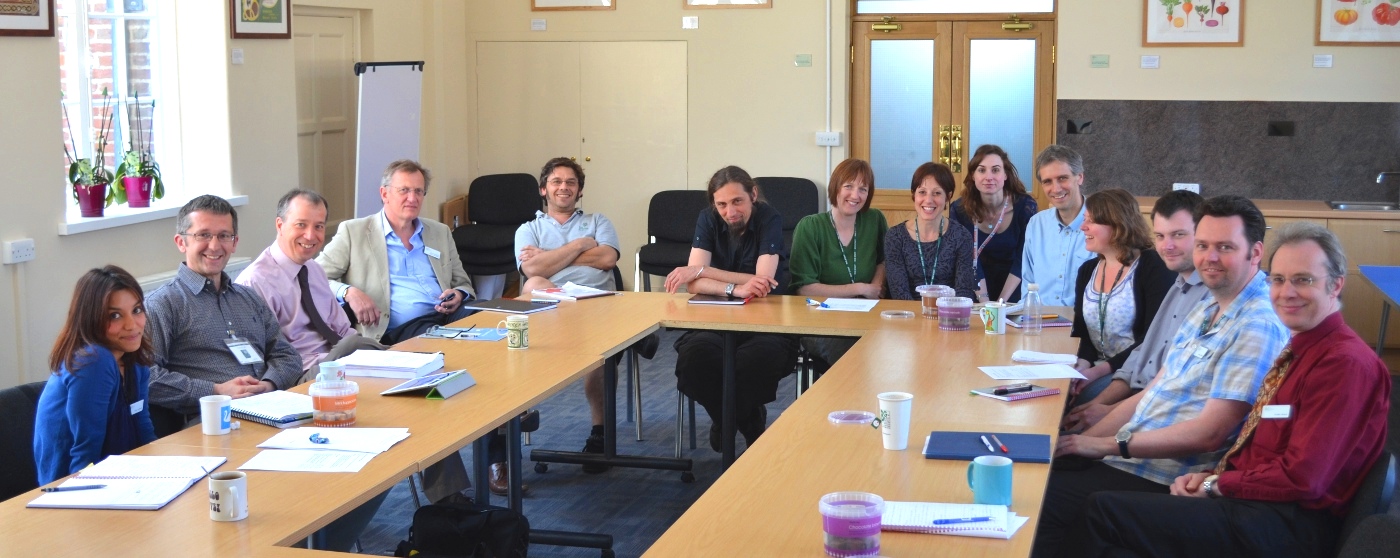
Discussing Science at Wisley in 1967


Many months before a KTP project begins and long before an Associate has been recruited, a core project team get together and, in a room I picture as being windowless and smoke-filled but that I expect in reality is bright, airy and houses multiple smoke detectors, they devise a plan outlining how the project could develop during the allotted timescale.  The result of their efforts is one of the first things I received on my first day as a KTP Associate – the grant proposal document.  Read and revisited for much of that day – and for many weeks afterwards, this document was rarely far from my desk.

Almost two years on, and with the project well on track, I still flick through my grant proposal document but do so much less frequently- perhaps only twice in a three-month period. This week, I revisited it when preparing for LMC6.

It’s another acronym I know. An internet search suggests it stands for the Large Magellanic Cloud, the London Medical Centre or the Livestock and Meat Commission; however, seeing as my first degree specialised in zoology (I’m not a physicist), I wail like a tantrumming two-year old at the briefest glimpse of a needle (I’m no doctor) and I’m a devout vegetarian (practically vegan, but for my love of cheese and cake), Google has on this occasion been uncharacteristically unhelpful.

Within the KTP-world, LMCs stand for Local Management Committees. Every four months, a group comprising the project team and an external, impartial KTP Advisor, meet to discuss the project.  The meetings provide a useful project health-check, providing opportunities to reflect on the project’s progress and request approval on proposed training, development and spending planned within the coming months.

For me, LMCs are a lot like the picture taken of the Science Committee at Wisley more than 40 years ago. Lots of brilliant minds (I’m excluding myself here, obviously), discussing Science.  There’s just fewer suits, more women, less grey hair and we’ve replaced the smoking pipes with chocolate hobnobs.


In an earlier post, I mentioned the KTP Training and Development budget which encourages Associates to develop their skills and knowledge to help them now as well as post-KTP. With June 2012 marking two years of our three-year KTP project, I decided to direct more attention to my training and development and, last Sunday, in search of new skills, I headed North.

My trusty SatNav led the way through snow and thick fog around the M25 and up the A1(M). Two hours later, and after I had long since tired of hearing myself singing really bad songs, really badly at the radio, my TomTom and I arrived in Peterborough.

Why Peterborough, you ask? Well, with a population less than a quarter that of Surrey and with notable past and present Peterborians including the co-founder of Rolls-Royce, Sir Henry Royce; TV presenter, Sir Jimmy Saville and the founder of Pizza Express, Peter Boizot, it was clearly well worth a visit. It also happens to be the hub of the RHS Media Department and home to the editorial teams responsible for the production of our in-house monthly magazine, The Garden, and our quarterly journals, The Plantsman and The Orchid Review.

The week involved working with the self-effacing, but brilliant teams responsible for producing the beautiful, glossy RHS magazines and journals that so often arrive on my desk throughout the year.  I spent much of the week learning how to rewrite material to fit the required word count, the importance of a good standfirst – the few, short sentences that sell a story to a reader, and the need to proof-read everything, at least twice. I sat amongst the 12-strong team who work on The Garden, the one-man and one-woman bands who edit The Plantsman and The Orchid Review and the fantastic trio that make up the online team who constantly update our web pages to keep them current and interesting.

A week’s worth of experience later and I can say with some conviction that working in the world of publishing involves continual change and a constant stream of fast-approaching deadlines.  For journals and magazines, rather than working in the present, you are forever focussed on the future. Whilst there is still snow on the ground and salt shortages in the supermarkets, you will be writing about feeding and deadheading bedding plants and coping with summer hose pipe bans in the garden. What’s really great is that a job in publishing provides regular, tangible evidence of your efforts – articles that people you have never met will pin on their fridges or in scrap books to read and re-read long after you’ve finished working on them.


It’s weird the things you remember from school.


I remember Occam’s razor: when competing explanations are otherwise equal, the simplest one is often the most likely, until evidence proves it otherwise. I also know that this wise philosophy is often misinterpreted to mean that the simplest solution is often the best.  Also committed to memory are the orders of the first ten elements in the periodic table and of the planets in the Solar system based on their distance from the Sun.  I know that the size of a turning effect or moment is dependent on the size of the force applied and on the perpendicular distance from the pivot, and that it is impossible to fold a piece of paper in half more than 7 times, irrespective of its size or thickness.


There is no doubt that at some point in my life, I will find a use for all of these nuggets of classroom-gained gold.  The first of these (the more commonly misinterpreted version, obviously) proved its worth not long after I started my KTP.


At a Plants for Bugs project meeting, the team were discussing the importance of quantifying the density of vegetation on the plots. What was needed was a method which could estimate, in such a heterogeneous habitat (comprising climbers, shrubs and low growing vegetation), how the structure of the vegetation varied from the ground to the canopy, throughout the year. This is important as a plot with lots of high-level canopy cover but little in the way of low-level ground cover is likely to support a different suite of invertebrates to one displaying the opposite trend. If invertebrate abundance and/ or diversity is influenced by plant origin, vegetation density may play some part in explaining the direction of this effect.

The idea was brainstormed and a number of options trialled. We dangled plumblines from clothing frames and toyed with the use of lasers to record the distance to ‘first vegetation’. Ultimately, we had to select the method which would provide a good estimate of vegetation density in a sensible amount of time.  We decided that simplest was best on this occasion, and adopted an idea involving the use of a checkerboard backdrop to record the number of squares obscured by vegetation at multiple height classes.


Monitoring vegetation density using a checkerboard composed of 20cm and 5cm squares (June and September 2011)


As estimates of vegetation density using this method will vary depending on the observer’s line of sight, it is important that the same person is involved in the recording throughout the experiment.  So, for two days this week, I’ll be out of the office and in the garden, monitoring this covariate on the Plants for Bugs plots.  I expect many of you may well be spending at least some of this time attempting to get eight folds from a sheet of paper.

It’s early morning and it’s cool enough for me to be wearing a good five layers of clothing but not so cold that my car windscreen needs scraping.  So it’s a little odd that I’m lugging a litre bottle of antifreeze around with me.  Stranger still that I’m nowhere near a car- any cars in fact, as I’m walking in a pretty determined fashion through Wisley garden and towards the Plants for Bugs plots.

No need to worry though. I am here for a very good reason.  Today, we’re setting pitfall traps – one of four methods used to regularly sample invertebrates on Plants for Bugs; the RHS research project designed to test whether invertebrate wildlife is at all bothered about the geographic origin of our garden plants.


Pitfall traps are composed of plastic drinking cups sunk into the ground and half-filled with diluted ethylene glycol (antifreeze). Traps are left in the ground for two weeks so that we can monitor the activity of all sorts of ground-dwelling invertebrates from ground beetles and woodlice to mites and springtails.


A freshly set pitfall trap, secured in the ground with a tent peg


In the past two years of recording, over 16,000 specimens have been collected from our pitfall traps and more than 250 species have been identified.  Now that the first traps of 2012 are in, we’ll have to wait a whole two weeks before we get any idea of what has been collected!


After two weeks in the ground, the contents of each pitfall trap are collected and returned to the lab for identification.  Photos courtesy of Helen Bostock (RHS)

Tick Tock

You’ve looked at your watch about five times in the past hour.  It’s hot and stuffy and the windows have that horrible warm-room condensation they get which leaves you boiling indoors but needing at least 15 layers of clothing to be warm outside. You’ve noticed that the overhead light bulb flickers 16 times a minute. You’re too scared to open a window in case someone thinks you’re asking a question and the person next to you is munching a tuna sandwich and spending an absolute eternity eating crisps ‘quietly’. 


We’ve all been there.  Lunchtime seminars. Sometimes you end up feeling that they’ve stolen an hour of your life you’ll never get back. 


Over a year ago, we risked these fears when we set up an internal seminar series for Science. But this one is different.  Its purpose is to engage and interest so talks are low on scientific jargon.  Being RHS Science, the topics are relevant and interesting to lots of people – not just scientists.  At least one window is always left open.  And there’s cake.  Better still – tea and cake.


‘Tea & Talk’ is an informal Friday afternoon seminar series set up through the KTP project to discuss our research activities amongst a multidisciplinary audience.  I am involved throughout the process from securing speakers and organising dates to advertising seminars and, quite excitingly, buying CAKE! 


Once a month, about 30 people come along to listen, discuss and absorb some new aspect of our Science. From the private lives of ladybirds to naming orchid hybrids; from hairy plants that help to cool our towns and cities to understanding why gardens make us happy.  For the scientists themselves, the talks provide an opportunity to peer-review a new research idea, to update others on newly completed work or to simply practice a talk that they need to give at an upcoming conference. For me (and everyone else), they help transfer knowledge within and between departments, boosting awareness of our scientific activities within the RHS.

What better way to spend 45 minutes on a Friday afternoon?!

A half-eaten box of Roses, a McVitie’s selection box, a dozen Christmas cards and a smattering of Hotel Chocolat chocolates are evidence that Christmas hasn’t quite left our office (yet). So, today, when there are a handful of pink and orange cellophane wrappers littering my desk and I feel the need to walk off one too many strawberry dreams or orange creams (all the best ones are gone), I take a brisk walk in the garden.


Down at the bottom of Wisley garden, past the Pinetum and the bird hide, you’ll still find splashes of colour in a set of 18 neatly arranged plots. There’s a fence around them, but you’re welcome to trundle in and have a nosey.  These 3m x 3m plots make up Plants for Bugs – a hypothesis-driven experiment investigating whether the geographic origin of garden plants significantly influences the invertebrate biodiversity. It’s a project that I provide hands-on assistance with (from weeding and watering to sampling and identification) and will undoubtedly keep referring to in later posts. So, whilst Plants for Bugs already received a brief mention last week, it really deserves a few more column inches here. 

The project addresses an important question.  What should we plant for wildlife? Research and experience means that we are all becoming increasingly aware of the important role our gardens play in attracting wildlife. The situation is exaggerated in towns and cities where in amongst the paving stones, car parks and private roads, our gardens can provide a welcome refuge for wildlife and together they can create a patchwork of wildlife-friendly stop-offs that link up the surrounding rural areas.  But with 70% of the plants in an average UK garden being non-native, this leaves us with a bit of a dilemma.  Do the 30% of native plants have a disproportionate influence on the wildlife they attract or do non-natives also provide a resource for biodiversity?


The project is set to run for three years.  During this period, data on the abundance and diversity of invertebrates on the plots are collected using a suite of methods that enable RHS scientists obtain a more complete picture of the invertebrate wildlife on the ground, on the leaves and in the air above our plots.


Results will be of real interest to gardeners and scientists alike and for those of you who want to provide a garden that makes it easy for wildlife whilst also being easy on the eye, you’ll be pleased to know the plots all look really stunning too!


 RHS Plants for Bugs plots in midsummer.  Photograph courtesy of Helen Bostock (RHS)

« Older entries