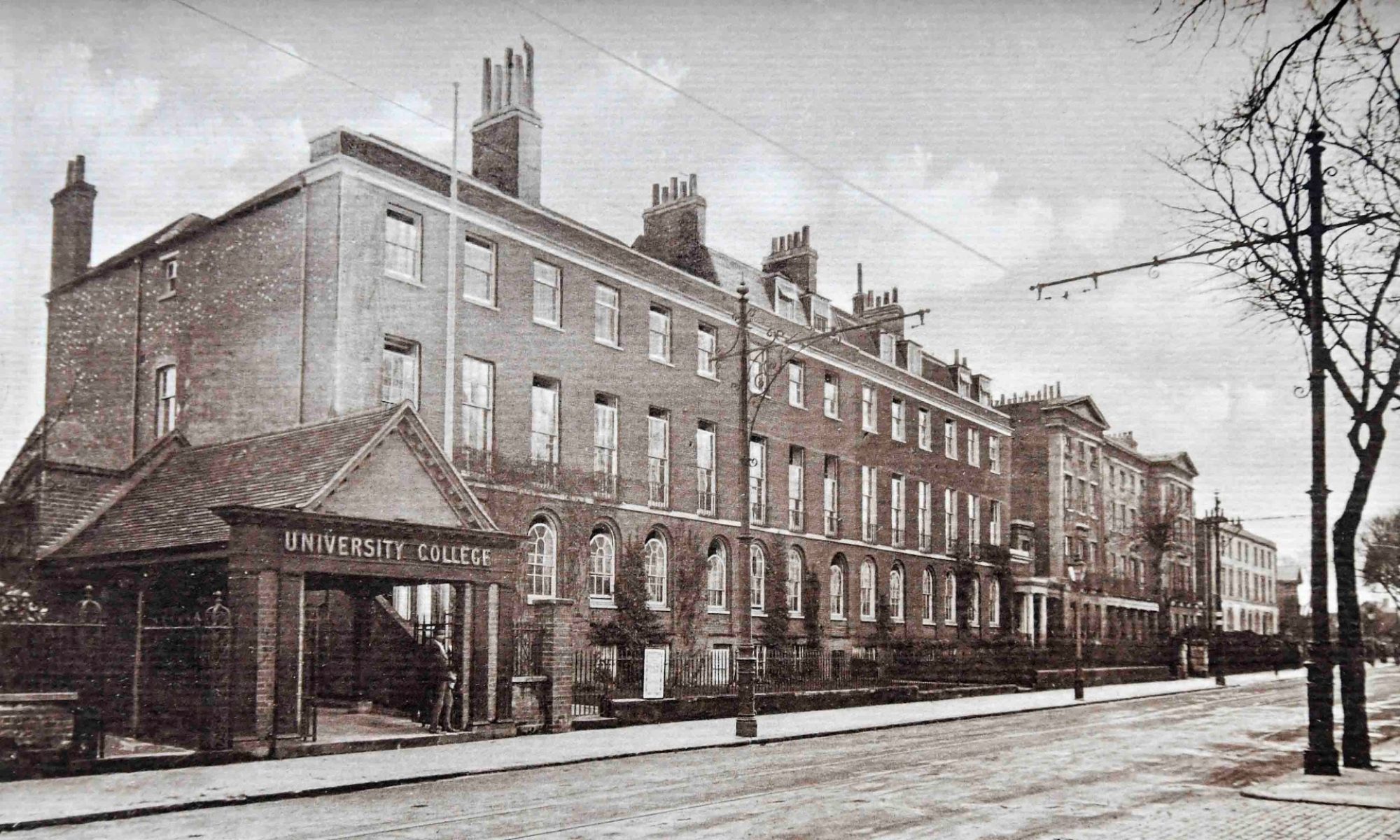
The Day Training College
In 1899 Reading College, a predecessor of the University of Reading, was recognised by the Education Department in Whitehall as a Day Training College. These teacher training institutions came about after the controversial Cross Commission of 1888. Members of the Cross committee couldn’t agree on the recommendations and a group of eight dissenters produced ‘minority reports’ that include the following:
‘We are of the opinion that it is desirable to give expansion to our present system of training by permitting students to lodge at home or in lodging-houses of approved character and respectability, to utilise the colleges and other places of higher instruction which are willing to aid in the training of teachers, and to encourage the formation of educational faculties in such colleges.’ (quoted in Barnard, 1949, p. 8)
This proposal was put into practice in 1890 when the Government agreed to approve and finance teacher training departments in universities and university colleges. The distinguishing characteristics of this new form of mainly elementary provision were that they were non-denominational and integrated the training with degree-level learning.
Reading’s Day Training College was led by J. H. Gettins who bore the impressive title ‘Master of Method’. I have mentioned Gettins before in posts about the Day Training Department and the so-called ‘criticism lesson’. It was only recently, however, thanks to a discovery by Dr Rhianedd Smith that I learnt of his footballing prowess.
J. H. Gettins
Joseph Holmes Gettins was born in Middlesbrough in 1873 into what appears to be a working-class family. He went on to excel at cricket and football and was to play as a talented amateur for Brentford, Middlesbrough, Millwall, the Corinthians and a number of lesser known clubs.
His career as an educator began as a pupil teacher at the Denmark Street Board Schools in Middlesbrough. He passed the Queen’s Scholarship Examination ‘in the First Class’, in 36th place nationally according to the Middlesbrough Gazette It was an outstanding result in an examination that could be taken by well over 7,000 candidates. The highest place attained by a Reading student the same year was an Ada Shearwood who came 78th and was congratulated in the Annual Report of Reading’s University Extension College.
This achievement enabled him to enrol at the Borough Road Training College in London in 1893 where he also became a tutor from 1895-99. As well as the Board of Education Teaching Certificate, he received a BA degree from London University.
The College’s recent move from Southwark to Isleworth had enabled sport to flourish as it owned playing fields for the first time, and it goes without saying that Gettins was a member of its football team, while also enjoying spells with other clubs.
It is claimed that, at the end of one period at Millwall in 1896, a bucket was passed round in his honour, and so many pennies were collected that he received an inscribed gold watch ‘as a memorial to his fine play’ (The Times, 19 June 1954, p. 8).

In 1896 Gettins played for the Corinthians in Hungary and the following year he was a member of their squad to tour South Africa, the first English team to tour outside Europe.
His photo appears in the volume ‘Famous Footballers 1895-1896’ which contains this description:
‘As a centre forward he is distinctly above the average. Fast as well as clever, a safe tackler and smart shot at goal, he has all the qualifications for a really first-class player. Twenty-two years of age, he is just under 6ft., and weighs 12st. 4lbs.’

The move to Reading in 1899 by no means curtailed his footballing activities; he continued to play intermittently for Middlesbrough and Millwall. And a headline in the Daily Mail in November 1899 – ‘Gettins Helps Reading to Beat Portsmouth’ – shows that he wasted no time in turning out for his local club:
‘[Gettins] held his men together in beautiful style throughout the match, and Reading’s success was very largely due to the excellence of his play. He opened the scoring in the first minute of the game.’ (Daily Mail, 9 Nov 1899)
As if that wasn’t enough, the College Magazine records him playing centre forward for the College Football team through 1901 and 1902.
From 1896 until well into the first decade of the 20th Century, the sports sections of the press are littered with references to Gettins, his many goals and the many teams he played for. His name could creep into match reports even when he wasn’t playing or was injured, to state, for example, that Millwall succeeded in winning despite his absence.
Nevertheless, he was no infallible Roy of the Rovers, as illustrated by this report of an uninspiring game between Millwall and Gravesend in which players kept shooting straight at the goalkeeper:
‘Gettins was a great sinner in this respect. He dribbled very powerfully, but his final efforts lacked both judgement and precision.’ (Daily Mail, 22 Oct 1900)
As time went by, however, references to Millwall seem to become fewer and those to Reading more frequent. In fact, Gettins was on the scoresheet when Reading beat Millwall 4-0 in 1906. There are also references to his playing for Queen’s Park Rangers in 1907 and for Croydon in 1909, two years after he had resigned from his post at Reading.
His Later Academic and Military Career
Gettins left University College, Reading in 1907 to become Principal of Liverpool University’s Training College for Men. He held this position until 1920, although his tenure was interrupted by war service – he had joined the Royal Army Service Corps in 1914 with the rank of Captain and received the DSO in 1918.
After Liverpool, Gettins was able to combine his academic background with his military experience. According to his obituary in The Times he attained the rank of Lieutenant-Colonel and held these posts:
-
-
- 1920 or 1921 (sources conflict), Chief Education Officer at Sandhurst;
- 1927, Command Education Officer, Eastern Command;
- 1931, Commander of the Army School of Education at Shorncliffe.
-
Gettins retired in 1933 and was awarded the OBE. He died at East Moseley in Surrey in 1954, aged 80.
Thanks to:
Phaedra Casey, Archivist (Reading Room and Acquisitions), for the image of Gettins at Borough Road College and information about the College.
Ryan Krage of Digital Technology Services for writing a facial recognition app that confirms Gettins’s identity on the Borough Rd photograph.
Dr Rhianedd Smith (Director of Academic Learning and Engagement, University Museums and Special Collections Services) for background information on Gettins and finding the ‘famous footballers’ image on eBay.
Sources
Although the Palace and Queen’s Park Rangers were beaten on Saturday and West Ham only drew, the three London clubs kept their places at the top of the table. (1909, November 15). Daily Mail, 11. [Gettins playing for Croydon]
Alcock, C. W. & Hill, R. (eds.). (1895). Famous footballers 1895-1896. London: Hudson & Kearns.
Barnard, H. C. (1949). A note on the term “Day Training College”. In H. Armstrong (Ed.), The Education Department through fifty years. University of Reading.
Beach G. (1891). The 1891 Scholarship Examination. Practical Teacher, 11, 1, 10-11.
Gettins helps Reading to beat Portsmouth. (1899, November 9). Daily Mail, p. 6.
Hamilton, E. R. (1958). An outline history of Borough Road College (1809-1958). https://www.brunel.ac.uk/life/library/ArchivesAndSpecialCollections/Documents/PDF/Hamilton-An-Outline-History-of-BRC-1809-1958.pdf
Joseph Gettins: https://en.wikipedia.org/wiki/Joseph_Gettins
Lieut.-Col. J. H. Gettins (1954, June 8). The Times, p. 10.
M.D. (1954, June 19). Lieut.-Col. J. H. Gettins. The Times, p. 8.
Poor Play at Millwall. (1900, October 22). Daily Mail, 6.
Reading College Magazine, Vols. I & II, 1901; Vol II, 1902.
Success of a Middlesbrough Teacher and Football Player. (1895, November 29). Daily Gazette for Middlesbrough.
University Extension College. 2nd Annual Report, 1893-4.