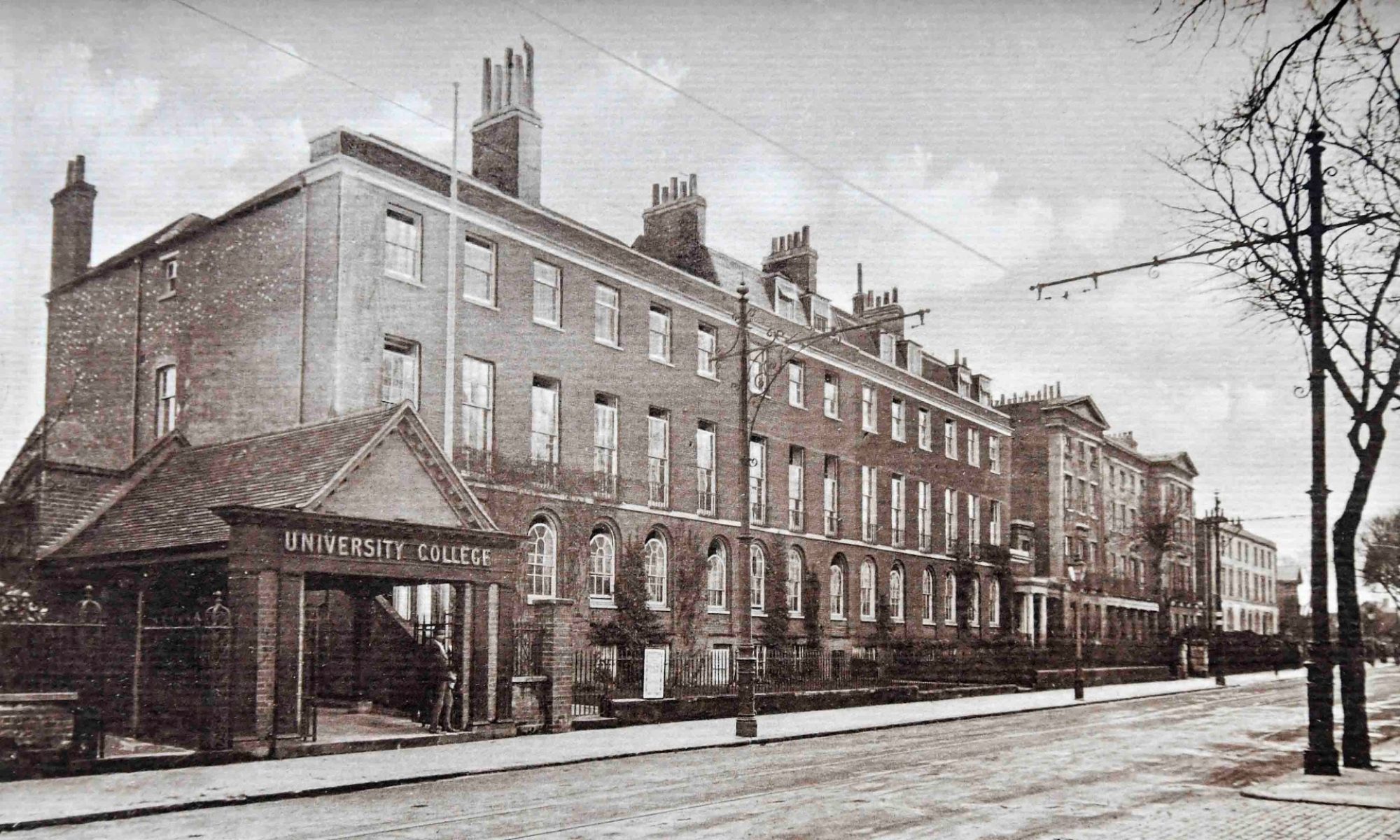
The London Road Gymnasium dates from 1914 and is situated on the western boundary of the campus. It was the gift of Dr Hurry, the College Medical Officer, and his wife Gertrude. The gymnasium was to prove a valuable resource for the Education Department.
Dr Hurry had been in post since 1899 and the offer was made on his retirement in 1912. The College’s annual report for that year expressed its pleasure and gratitude to the benefactors who:
‘… upon so many occasions have manifested a generous interest in the welfare of the College … A gymnasium is greatly needed, and such a gift is most welcome. A site has been selected in consultation with Dr. Hurry, and plans will shortly be laid before Council.’ (Report of Council, 1912, p. 5)


The project was completed in 1914 when the official opening was performed by Mrs Hurry. The College annual report described the building as consisting of:
‘… a hall of sixty feet by thirty feet, a gallery for spectators, dressing room, and instructor’s room … the design and equipment of which has earned high approval from experts.’ (Report of Council, 1914, p. 6)

The benefits of this new facility were felt immediately by Education students; the Report of the Academic Board for 1914 notes under the heading ‘Primary Training’:
‘Excellent accommodation for the physical training of the students has been provided in the new College Gymnasium. Mr S. Jennings was appointed Instructor in Physical Exercises, and a new stimulus was given to the teaching which resulted in a very favourable report on both the men and women students’ work being forwarded to the College by the Board of Education.’ (Report of the Academic Board, 1914, p. 36).
Nowadays we take it for granted that schools, colleges and universities are well equipped with sports facilities. At the beginning of the 20th Century, by contrast, there seem to have been fewer such expectations, and Reading’s superior facilities clearly gave it an advantage when it came to taking part in schemes funded by the Board of Education in London. Thus, in 1917-1918, the College was invited by the Board to implement an experimental project for the training of certificated women teachers in Physical Exercises:
‘A year’s course is provided and is being attended by 24 women students, many of them from the North of England. … A Lecturer in charge and a whole-time assistant have been engaged to give instruction and training. The selection of the College for this important experiment was largely owing to its possession of an excellent Gymnasium with modern equipment.’ (Report of Council, 1918, p. 5)
The course was held annually until the end of the 1923-24 Session when the Board of Education withdrew funding and, sadly, the College was forced to close it down:
‘The success of the course from an educational point of view was remarkable, but the expense of conducting it, and the comparatively small number of teachers who were able to give up a year for the purpose of attending it, caused the Board of Education to withdraw the financial support which alone had made it possible for the College to undertake the work.’ (Report of Council, 1924)
In total, 120 women followed the course over 6 sessions. Many of these went on to obtain posts in a variety of schools. For others, however, the course served as a stepping stone into administrative posts with Local Education Authorities or lecturing in training colleges.
A note about Dr Hurry
Dr Jamieson Boyd Hurry (1857-1930) was a philanthropist and polymath who practised medicine in Reading for over 40 years. He was also a botanist and expert on Reading Abbey who published widely on Medicine, History and social issues.

As well as his gift to University College, Reading, it was Dr Hurry who donated the land for the town of Reading’s Arthur Hill swimming pool (Hurry’s wife Gertrude was the daughter of Arthur Hill). His generosity extended way beyond Reading, however, as is shown by an obituary in the British Medical Journal that expressed appreciation for his endowment of a Studentship in Physiology to Cambridge University:
‘Dr. Hurry was peculiarly generous in his public gifts. He seemed to realize that it is a duty of those possessing wealth to spend much of it for the benefit of the public rather than for private luxury.’ (Allen, 1930, p. 475)
THANKS TO
Dr Rhianedd Smith (Director of Academic Learning and Engagement, University Museums and Special Collections Services) for information about Mrs Hurry and the Arthur Hill swimming pool.
Sources
Allen, F. J. (1930). The Late Dr. Jamieson B. Hurry. British Medical Journal, 1, 475.
Reading College. Calendar, 1899-90.
University College, Reading. Annual Reports of the Academic Board, 1914 & 1924
University College, Reading. Annual Reports of the Council to the Court of Governors, 1912, 1913, 1914, 1918 & 1924.
University College, Reading. Calendars, 1911-12, 1912-13.
University of Reading Special Collections. University History Collection: Box MS 5305, Photographs – London Road.