Children’s Author almost Expelled from the College

Kathleen Hale, OBE (1898-2000) was an artist and children’s author best known for her stories about ‘Orlando, the Marmalade Cat’ about whom she wrote and illustrated nearly 20 episodes. She created Orlando thanks to a shortage of suitable literature to read to her four-year-old son; she was so tired of bedtimes filled with Beatrix Potter and Babar the Elephant that Orlando was created as a substitute. According to her obituary in The Guardian, Hale despised the style and values in Enid Blyton’s books, calling her ‘the Pied Blyter’. She would never have inflicted them on her own children!

School in Manchester

Hale was born in Scotland but brought up in Manchester where she attended the Manchester High School for Girls. She was a rebellious teenager, described by her headmistress, Miss Sara Burstall,  as ‘uneducable and the naughtiest child she had ever had to deal with’ (Hale, 1994, p. 26) (see Women and Higher Education for the link between Sara Burstall and University College, Reading).

In spite of spending most of ‘nine years at the school sitting in the corridor in disgrace’, Hale’s artistic talent was nurtured by a new art teacher, the progressive Miss Ritchie. As Matriculation approached it was clearly pointless for Hale to sit the examination. Instead, Miss Ritchie sent samples of her drawings to University College, Reading. The outcome was a two-year scholarship – two of these were being offered in Fine Art during this period. Her scholarship is recorded in the College’s annual reports in 1916 and 1917.

Hale was still too young to take up the award, however, and had to spend an extra year at school. Miss Burstall had the sense to let her study what she liked and what she was good at: Art, English Literature  and French. She was also allowed to attend life-drawing classes at the Manchester School of Art.

University College, Reading-first impressions

In 1915 Hale enrolled in the Department of the Fine Arts led by Allen W. Seaby. Her reaction on arriving at the College is reminiscent of Elspeth Huxley’s disillusionment. Unlike Huxley, she didn’t compare the Great Hall to an outsize garden shed, but she did express her disappointment:

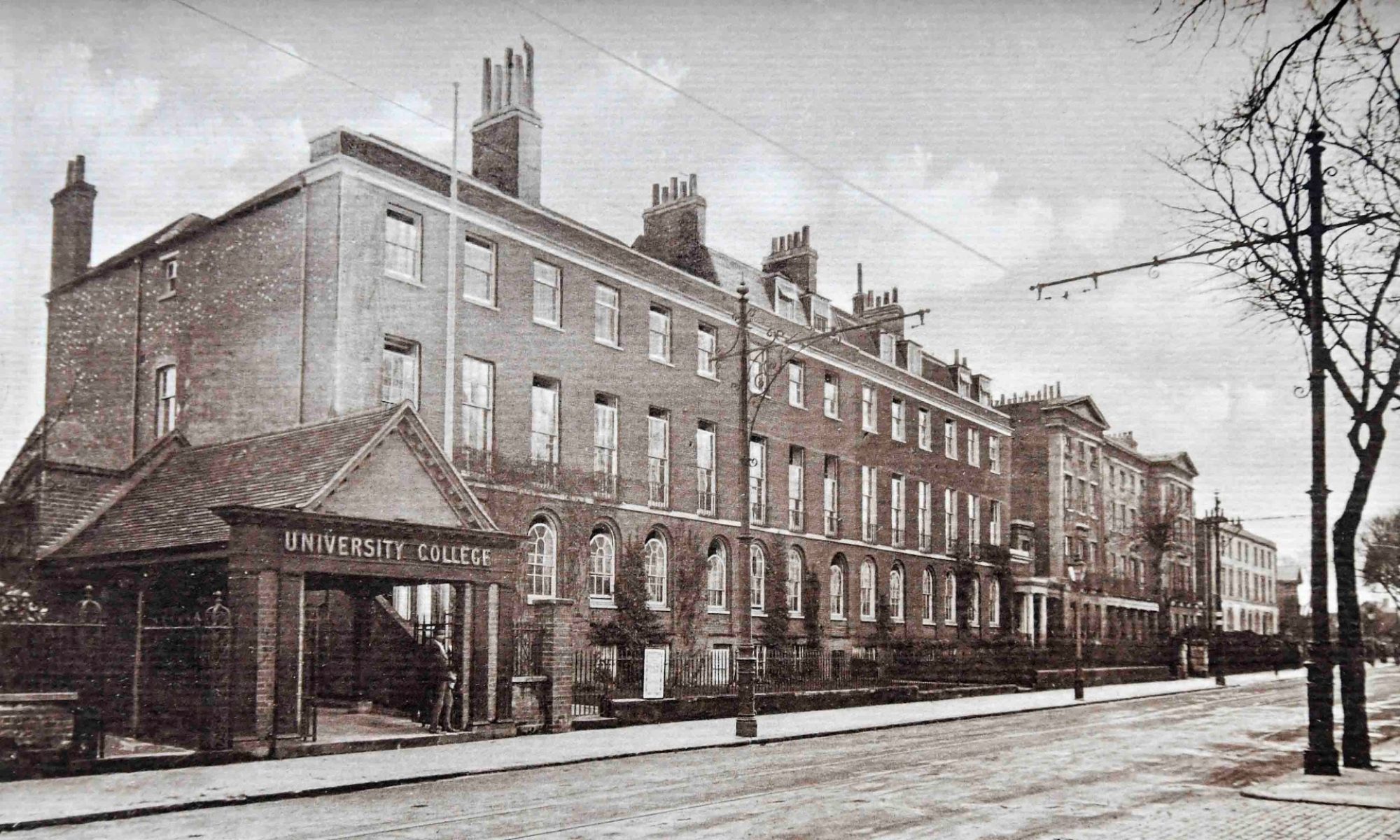
‘From what I had heard of the dreaming spires of Oxford and the backs of Cambridge, I imagined ancient stone buildings drenched in history and drama. I arrived in an almost incandescent ecstasy of anticipation, only to be deflated by the tall, dark-red, Victorian edifice at which I had to announce myself. Nor were my spirits lifted by the rest of the college, which consisted of one-storey departments catering for various branches of learning, linked by ‘cloisters’ paved with cement and with tiled roofs supported by prosaic wooden posts instead of the traditional stone pillars.’ (Hale, 1994, p. 43)

No doubt the dark-red, Victorian edifice was ‘The Old red Building’ that faced London Road and housed the College adiministration.

Illustrates the quotation about the ORB
The Old Red Building on London Rd 4-5 years before Hale’s arrival

The Fine Arts Department was no better – it was small and cramped; life models weren’t available (apart from a ‘depressed’ owl in a cage); history of art lectures reminded her of school; the war had left a shortage of staff and students and there was nobody qualified to teach oil painting. There were only five other students, one of whom soon disappeared. It was a sad contrast to the lively, slightly bohemian atmosphere of the Manchester School of Art.

Nevertheless, she settled into college life and enjoyed the courses she attended, including agriculture for which she had to borrow a cap and gown. Eventually, she was to become a close friend of Allen Seaby whom she described as ‘a wry old man, brittle with rheumatism, but as cheerful and alert as a bird’. In her autobiography she explains how he taught her to produce traditional Japanese woodcuts.

A close shave!

There was, however, one blot on the horizon – at the beginning of her autobiography, Hale explains that twice in her life she had narrowly avoided expulsion for immorality or indecency. The first, at the age of twelve, was for drawing bare-breasted mermaids in the margin of her religious textbook. The second, at Reading, was for having her hair ‘cut in short bob with a fringe’ (Hale, 1994, p. 7) for which she was summoned before a special meeting of the College governors. Being hard up at the time, she had sold the hair for £5.

This is how she told the story to Sue Lawley on Desert Island Discs in 1994:

KH:  ‘It was so long and so heavy [that] when I did it up with hundreds of hairpins it would slowly uncoil and slide down the back of my neck with [the] hairpins too. So it was quite long.’ 

Sue Lawley:  ‘But it was quite a racy thing to do, really, to cut your hair off short.’

KH:  ‘Yes, yes. I wasn’t the first, but at the Reading University [sic] I was, and they said I’d have to go down. They couldn’t accept [it]. I said, well, I haven’t cut off my morals with my hair and then there was a long silence and I found I was still enrolled as a student.’

The matter was never mentioned again and she continued with cropped hair for the rest of her life.

College Life

Otherwise, apart from some anxiety about her body shape, all was well. She had a single room in St Andrew’s Hall, took advantage of the sports facilities, playing tennis, skating in the winter, joining the rowing club and learning to punt – a sharp contrast to her hatred of sport at school.

She was particularly impressed by Dr Hugh Percy Allen, Director of the Music Department and a charismatic teacher. She joined his choir but didn’t actually dare to sing; she mimed the words in silence. When Dr Allen became aware that she had no voice he allowed her to remain as a reward for her enthusiasm.

St Andrew’s Hall was ruled by the eagle-eyed warden, Miss Bolam, who keenly enforced the rule that students should attend a place of worship on Sunday mornings. Hale found a solution to this:

‘… when it was time for church and I had to walk past Miss Bolam sitting at her window, I ostentatiously carried a volume much the same size and colour as a hymn-book; then I would spend the morning peacefully reading in a field, and mingle craftily with the churchgoers on their return. But the lady sensed my deception and blandly questioned me on the content of the sermon and the choice of hymns. I tried to placate her, assuring her that I spent Sunday mornings in the contemplation of God’s presence in nature. She was better able to understand my spending some of my Sunday mornings at Quaker meetings…’ (Hale, 1994, p. 48)

Shows engagement with the Department
Extract from the College Calendar of 1916-17 showing Hale on the Executive Committee of the Art Club

Hale’s scholarship ended in 1917 when she was 19. There is surprisingly little information available about her examination results, just a single mention in 1916 of passing History of Painting, part of the Diploma in Fine Arts. There seem to be two reasons for this lack of documentation. First, Fine Arts students were exempt from some of the assessment that other diploma students underwent. Second, even though diploma courses usually lasted two years, Fine Arts (and Music) required three. So Hale was a year short of completion.

The Governors of the College offered to extend the scholarship for a year in acknowledgement of her ‘dedication and talent’ but Hale was anxious to see what ‘Life’ was like:

‘I sold my excellent bicycle for the price of a single ticket to London, and set out with only a few shillings in my pocket, my pince-nez delicately chained to one ear and no qualifications whatsoever for earning a living.’ (Hale, 1994, p. 51)

Return Visit to St Andrew’s Hall

In 1978 the University Bulletin recorded that an eighty-year-old ‘distinguished visitor’ had returned to St Andrew’s Hall. Kathleen Hale, now Mrs Douglas McClean, was photographed on the stairs in the entrance hall which now (in 2026) is the exhibition area for the MERL and Special Collections. It was here that the young student had heard classical music for the first time, sitting on the stairs and listening to concerts given by the music students. She claimed she had never seen a piano before, let alone a cello, violin or flute.

Hale's revisit
Kathleen Hale revisits St Andrew’s in May 1978

Hale was welcomed by Dr Elizabeth Edwards, Warden of St Andrew’s, and shared anecdotes such as the time when members of the Royal Flying Corps, then occupying Wantage Hall because of the war, invited the women of St Andrew’s to a dance. The College authorities refused permission, but Miss Bolam subsequently agreed to invite the airman to a dance in her own hall. There were enthusiastic preparations by the women, but the men took their revenge by not turning up.

Postscript

The University of Reading’s Art Collection holds six portraits by Kathleen Hale, all completed in 1920, well before the first Orlando story. They include the large pencil drawing below. The other five, together with information about Hale’s early struggle for recognition as an artist, can be viewed on the Art Collections website. There is much more to Kathleen Hale than Orlando!

Example of Hale's works
Kathleen Hale, Portrait of a French Peasant Woman, pencil on paper, 1920, UAC/11071. © Estate of Kathleen Hale
Thanks to:

Michele Drisse (Reading Room Supervisor, Museums & Collections); Dr Hannah Lyons (Curator of University Art Collections) and Sharon Maxwell (Archivist, Cataloguing & Projects) for their help with this post.

Sources

Desert Island Discs, 30th October 1994. Kathleen Hale – BBC Radio 4.

Hale, K. (1994). A slender reputation. London: Frederick Warne.

MacCarthy, F. (2000, January28). Obituary: Kathleen Hale. The Guardian.

Parkin, M. (Ed.) (2001). Memorial Exhibition: Kathleen Hale 1898-2000. London: Michael Parkin Fine Art.

University College, Reading. Annual Report of the Academic Board, 1915-16 & 1916-17.

University College, Reading. Calendar, 1915-16 & 1916-17.

University of Reading Bulletin, May 1978, No. 102.

University of Reading. Calendar, 1977-78.

The University Bulletin and the Harassment of the Vice-Chancellor

The University of Reading Bulletin replaced the Vice-Chancellor’s Newsletter in March 1969 and continued to be published until June 2009. It is a valuable repository of monthly (later fortnightly) details of the University’s history over a period of nearly thirty years. The complete collection is held in the University’s Special Collections and can be accessed in the Reading Room at the MERL.

The Bulletin contains news from the University Court and Council, information about staff retirements and appointments, graduations, visits abroad and foreign visitors, course changes, finances, research grants and contracts, publications, student issues, sport, accommodation and obituaries as well as readers’ letters and a regular true-or-false quiz about the University.

Early issues were thin and unsophisticated, crudely stapled in one corner. Gradually,  however, the quality of reproduction improved, photographs (eventually in colour) were included and the presentation became glossier. In May 1974 double columns and a smaller type (Baskerville 9pt) were used for the first time. The final, 500th, issue shown below traces the evolution of the front cover.

Final issue
The last Bulletin (June 2009), showing previous front pages. The first issue is top left.

Occasionally copies contain an insert, and when I opened the issue from June 1973 a sheet of paper fell out with an unattributed account of the harassment of Harry Pitt, the then Vice-Chancellor. The following is a condensed version:

The student Rally ended at about 3.40 p.m.. Shortly afterwards a group of students was seen approaching Whiteknights House. The Vice-Chancellor had decided that he would not receive a deputation and left Whiteknights House to go to the Blandford Lodge car park. As he neared the car park he was seen by some students and they began to run towards the car park. The Vice-Chancellor had started to drive off but had missed the exit from the car park. He began to reverse and the students were slow in giving him passage. A group of students then pushed the back of the Vice-Chancellor’s car so that he could not continue to reverse. He got out of his car and walked towards Park House under the colonnade of the FURS Building.

The students followed shouting slogans such as “Pitt Judge! Pitt Jury!” On reaching the end of the colonnade the Vice-Chancellor turned back to return to his car, still surrounded by the students shouting slogans. He got into his car to drive away and a group of students sat down in front of it. He left the car and began to retrace his steps.

Still followed by the shouting group, the Vice-Chancellor turned towards the Faculty of Letters and Social Sciences building and then along the Queen’s Drive. On reaching Shinfield Road the student leaders were reminded that they were now on the public highway and if they caused an obstruction could be dealt with by Police. The students then dispersed.

There was no actual violence or jostling of the Vice-Chancellor but the students kept up a continuous shouting and jeering and surrounded him at all times. There were 30 to 40 at the beginning, but 75 or more at the end. Some were carrying furled banners and were probably not Reading students. But among the group there were certainly some students of the University.’

Background to the Protest

The events leading up to the demonsration are outlined in a ‘Note by the Vice-Chancellor’ in the copy of the Bulletin mentioned above. Here is an attempt at a chronological account:

      • The erosion of student grants by inflation had resulted in a national campaign by the NUS.
      • At Reading this became acute in October 1972 when there was a substantial increase in hall fees. This led to a rent strike with threats of direct action unless the increase was removed or at least reduced.
      • The University Council stuck by the original decision and, following a vote at a Students’ Union meeting, Whiteknights House was occupied for 3 weeks.
      • Despite the disruption, the work of academic departments carried on as normal and, after the students had voted to end the occupation, no disciplinary action was taken.
      • The rent strike ended and steps were taken to improve the accommodation system.
      • In January 1973 students resumed their rent strike in support of the NUS campaign over grants. There was peaceful picketing and academic staff were sympathetic – after all, the target was the government and there was no intention to harm the University.
      • An extended rent strike, however, was a threat to the institution and the Standing Committee of Council believed there was a duty to collect money owed.
      • Students were told that if they did not settle their bills they would be denied payments from the Vacation Grant Fund, be refused hall places for the following summer term and the University would not process their Local Authority grant cheques.
      • In protest, students disrupted a Senate meeting on 28 February 1973 and carried out a ‘token’ occupation of Whiteknights House on 21 March. No disciplinary action was taken.
      • On 11 May about 30 students occupied the Registrar’s office until the V-C and Deputy V-C (Prof Cyril Tyler) agreed to talk to them in the Staff Common Room.  Here the students intended to keep them locked in until they agreed to withdraw the letters to Local Authorities. Pitt, however, had a key to one of the doors and he and Tyler escaped.
      • On 16 May students occupied Whiteknights House while Senate was meeting elsewhere. Some members of Senate forced an entry and identified 14 students on whom fines were later imposed.
      • Staff who worked in the building expressed their gratitude to those who ended the occupation; it belonged to a sequence of events during which they had experienced ‘harassment, disruption of work, threats and physical intimidation’ (Bulletin, June, 1973, p. 30).
      • The demonstration (see image below) and harassment of the V-C took place on 13 June.
      • The University had prepared for solicitors to threaten writs in respect of fee defaulters and their guarantors (usually parents). In the event, fewer than 100 solicitors’ letters were sent and no writs were issued. The fact that students would not automatically receive their grants caused most of them to settle their accounts.

Thus the affair died down with the beginning of the summer vacation, though there were still appeals against the fines to be dealt with. Six of the students who had been fined and wanted to appeal had reached the end their courses. They were nevertheless allowed to graduate.

Demonstration in 1973
The protest of 13 June 1973 (University of Reading Special Collections).
Sir Harry Pitt (1914-2005)

Harry Pitt was Reading’s Vice-Chancellor from 1964 until 1978, He was a highly respected academic, a mathematician renowned for his work on probability theory and Tauberian theorems.

A mild-mannered, modest man, he found himself caught between understanding the legitimate grievances of students and what he regarded as the duty of a publicly financed institution to collect money that was owning. That the protests were directed against the government rather than universities or those who ran them was little consolation. Pitt sympathised with the cause but not the tactics; he wrote to Margaret Thatcher, then Secretary of State for Education, at least twice. The Bulletin of July 1973 reported that Pitt’s second letter to Mrs Thatcher expressed:

‘…the Council’s concern that the increases in students’ grants recently announced were still inadequate for their needs; that there should be an annual review of grant rates; and that married women students should receive grant [sic] on the same basis as single students.’ (Bulletin, July 1973, p. 6)

Photo of Pitt. Cf painting
H. R. Pitt (Downloaded from https://royalsocietypublishing.org/ on 05 October 2025).

In his history of the first 50 years of the University, Professor Holt credits Pitt with introducing a new management style:

‘Pitt would encourage and restrain; he could lay down the constraints and limitations, whether moral, academic or financial, with great firmness; but he sought a consensus, a genuine communal decision, in the first instance from senior academic staff. Those who still wished to be led or directed found the new regime mild and apparently formless. In fact it re-fashioned the University as a self-governing community.’ (Holt, 1977, p. 289)

It is probably an understatement to say that Pitt’s tenure as Vice-Chancellor offered serious challenges. This was a period of rapid expansion and student unrest during which Reading’s student population rose from 2,000 to nearly 6,000. Nevertheless, Pitt successfully steered the University through these difficulties and received an honorary DSc from Reading University in 1978. He was knighted the same year for distinguished service to higher education.

Pitt's honorary degree
This issue was published in the month of Pitt’s retirement and shortly before his receipt of an Honorary DSc in December 1978. The painting by Norman Blamey was the first winner of the Roy Miles Award and had been on display at the Royal Society Exhibition earlier that year. It is part of the University Art Collection (Object no.UAC/10092).
sources

Holt, J. C. (1977). The University of Reading: the first fifty years. Reading: University of Reading Press.

University of Reading Bulletin, June 1973, No. 43.

University of Reading Bulletin, July 1973, No. 44.

University of Reading Bulletin, December 1978, No. 109.

University of Reading Bulletin, January 1979, No. 110.

The Kennington Portrait (1939)

William MacBride Childs (1869-1939) was the driving force behind the transformation of a college that Edith Morley once described as ‘insignificant and unknown’ (2016, p.97) into a fully-fledged university. Childs became Reading’s first Vice-Chancellor in 1926, only to retire three years later, when he was replaced by Franklin Sibly (later Sir Franklin).

Childs was only sixty on retirement, but had been a member of the College and University for thirty-years, Vice-Principal for three, Principal for twenty-three and Vice-Chancellor for three years. Now that the Royal Charter had been achieved, he felt that his mission was complete:

‘My innings had been a long one …. In December 1928, I was certain that in deciding to lay down my office at Michaelmas, 1929, I was acting rightly; and I have been certain of it ever since. I had done for Reading all I could; and when a man feels that, it is time for him to go.’ (Childs, 1933, p. 191)

An account of Childs’s retirement is to be found, not in his own memoir, but in the writings of his son, Hubert. Since 1922 Hubert’s father had been toying with the idea of preparing for retirement by building his own house, and in 1923 bought three acres of land near Grimsbury Castle in Hermitage, Berkshire. It was a monumental task and Childs Senior was no builder, but with the help of his sons and using the university vacations, Grimsbury Bank was ready for occupation by the summer of 1929.

Grimsbury Bank, W. M. Childs’s retirement home (image from H. Childs, 1976)

It was at Grimsbury Bank that W. M. Childs sat for his official portrait as former Vice-Chancellor some years later.

 The kennington portrait

‘It had always been intended to record Childs’s retirement in 1929 in the customary manner with the presentation of a portrait.’ (Holt, 1977, p. 100)

Childs suffered from poor health in 1936 and was seriously ill in 1937. By now some of his friends and former colleagues, as well as people connected with Wantage Hall, felt it was high time that the idea of a formal portrait should come to fruition.

Franklin Sibly, the then Vice-Chancellor, placed the responsibility in the hands of Anthony Betts (1897-1980), Head of the Fine Art Department. Betts was a friend of Eric Kennington (1888-1960) the renowned illustrator, portrait painter and official war artist, who was persuaded to carry out the commission at a beneficial rate. Records of the Friends of the University of Reading show that they contributed £50 (approximately £2,857 in today’s money) towards the project. The grant was awarded to Wantage Hall, however, and it isn’t clear exactly how the picture was financed.

Work began in November 1938 following a delay due to Kennington’s other commitments. The ‘great chair’ sporting the University’s coat of arms in which Childs was to be seated was transported to Grimsbury Bank.

According to Hubert Childs, Kennington’s approach was to work in his own studio from photographs and pastel sketches completed during sittings at Grimsbury. One such sketch has survived and is held in the University’s Art Collection, though the medium appears to be only partially pastel (the pink area in the image below).

Head and shoulders study of William MacBride Childs (University of Reading Art Collection (UAC/10021)

At first, there was good progress, and there was a friendly rapport between artist and sitter. Early in 1939, however, work practically came to a standstill while Kennington was engaged by the War Office to advise on camouflage techniques in preparation for war.

With the delay, Childs became agitated until Kennington agreed to three final sittings. The portrait was completed in March 1939 but not before surviving a major hiccup that was still to be a source of hilarity in years to come.

The three graces?

Once the head was finished, all that remained was the background which the artist was able to paint in his own studio. When Dr and Mrs Childs inspected the portrait complete with background, however, it was clear that all was not well. Childs wrote to his son:

‘With the best intentions, Kennington put in a quite impossible background about which I will tell you some day. It had to come out.’ (H. Childs, 1976, p. 195)

According to both Professor Holt and Johnny Johnson in his Random Recollections, the background in question was a copy of a famous tapestry depicting the Three Graces. Hubert Childs, on the other hand, described it rather differently:

‘The quite impossible background was taken from a fifteenth-century tapestry in the Louvre, and figured young men and maidens disporting themselves.’ (p. 195)

Exactly why these images caused such offence isn’t clear. Notes about the painting written by Professor Betts in 1974 state unequivocally that the figures from the 15th Century tapestry were female and clothed. Nevertheless, the Childs family regarded them as totally unsuitable for display in a male hall of residence. It was likely, as Hubert so delicately put it, ‘to give rise to ribald comment.’

The upshot was that Anthony Betts had to persuade Kennington to alter the background. Johnny Johnson, a future Registrar of the University, recalled it like this:

‘Poor old Anthony Betts,  don’t think he quite knew what to do, but he said he would see to it and told Eric Kennington about this, who I think was slightly miffed! I think the proof of the fact he was slightly miffed is that he immediately painted out the tapestry that he had so very carefully painted in. He painted it out with black, and that’s why the portrait of Childs had a completely black background’ (Johnson & Sibly, c1984, p. 2)

In Hubert Childs’s version, Kennington was rather more than ‘slightly miffed’ and threatened to give up the commission, only to be pacified by Mrs Childs who was able to convince him to make the changes.

The Finished portrait: ‘3/4 portrait of Childs, in profile, dressed in red and grey academic robes, seated in chair with University arms, against a ‘landscape’ background. Signed and dated bottom right’ (University of Reading Art Collection, UAC/10064)
The presentation

Childs passed away on 21 June 1939, only three months after the completion of the portrait. The Vice-Chancellor’s Annual Report for 1938-39 recalled the presentation of the portrait to Wantage Hall, an institution that was particularly close to Childs’s heart, and where he had lived with his wife when it was first opened:

‘It was a source of peculiar gratification to the members of the University that Dr. Childs, with Mrs. Childs, was able to be present at Wantage Hall on May 13, when his portrait in oils was presented to the Hall, on behalf of former members of the Hall and the Friends of the University, by the Chancellor, Sir Samuel Hoare.’ (Proceedings, 1938-9, p. 32)

The presentation marked Childs’s final engagement at the University and his final speech. It was a considerable effort but he spoke enthusiastically about the contribution that Wantage Hall had made to the University community. He received a warm and attentive reception.

In his history of the University’s first fifty years, Professor Holt sees the portrait as being ‘of a dying man, his earlier fires now only aglow’ (p. 100). Nevertheless, we’ll leave the final word to the subject himself:

‘The portrait is generally regarded as a success. It is certainly a fine picture, not quite what I expected, or ideally would have preferred.’ (H. Childs quoting his father, 1976, p. 195)

Thanks

To Dr Hannah Lyons, Curator of the University Art Collection for help and support, and for providing access to the head and shoulders study.

Sources

Betts, J. A. (29 January 1974). Account by Professor J. A. Betts of Painting of Dr. Childs’ Portrait by Eric Kennington. Artist File, University of Reading Art Collection, UAC/10064.

Childs, H. (1976). W. M. Childs: an account of his life and work. Oxford: Alden Press.

Childs, W. M. (1933). Making a university: an account of the university movement at Reading. London: J. M. Dent & Sons Ltd.

Holt, J. C. (1977). The University of Reading: the first fifty years. Reading: University of Reading Press.

Johnson, J. F. & Sibly, T. C. F. (c1984). Random Recollections of the University of Reading. Reading: University of Reading.

The Friends of the University of Reading. Record of grants awarded: http://thefriends.org.uk/friendsreport/grants-awarded/

University of Reading. Annual Statement by the Vice-Chancellor. Proceedings of the University, 1938-39.

Walter Sickert and Patricia Cornwell

‘It’s bizarre to consider that Jack the Ripper was awarded an honorary doctorate from Reading University’ (Patricia Cornwell, 2017, Ripper: the Secret Life of Walter Sickert, p. 436)


Anyone reading my previous post about Walter Sickert’s degree ceremony  might wonder why, in 2002, a famous American thriller writer should  fund the conservation of Sickert’s drawings in the University’s art collection.

Café Chanteuse, c.1904, one of 18 drawings by Walter Sickert in the University of Reading Art Collection (UAC/10531)

The author in question is Patricia Cornwell, best known for her series of crime thrillers featuring Kay Scarpetta, a forensic expert and medical examiner. Following an invitation to tour Scotland Yard in 2001,  Cornwell became convinced that Walter Sickert was responsible for the Whitechapel murders, and has expounded on her theories in interviews, documentaries and three books.

Having once worked as an analyst for the Chief Medical Examination in Richmond, Virginia, she resolved to conduct a forensic investigation into Sickert’s connection to the Jack the Ripper cases:

‘Walter Sickert was connected with Jack the Ripper long before I appeared on the scene. I’m not the first one to think of him. But I’m the first to investigate him the same way we would a suspect today.’ (Cornwell, 2017, p. 448)

The Donation

Cornwell’s donation was news to me when I read about it in Naomi Lebens’ ‘Rubens to Sickert: the Study of Drawing’ (2021), but I remembered that in 2001 or 2002, Dr Sue Malvern, Senior Lecturer in the History of Art Department, had been approached by Cornwell while she was working in an archive somewhere. Dr Malvern remembers it like this:

‘The Cornwell story is fairly convoluted. I did meet her in an archive. I can’t remember exactly where, possibly the archives at the Tate. She was pursuing a theory that Walter Sickert was Jack the Ripper, and was there with her assistant. I’m not a Sickert scholar but suggested Anna Robins who is. Anna Robins appears in a BBC Omnibus programme, Patricia Cornwell Stalking the Ripper,  30 Oct 2002. It’s still available on iplayer. So it was a long time ago, but I’m sure that’s how Cornwell came to make a donation… (Email, 26 April 2024)

Anna Gruetzner Robins, Professor Emerita in the School of Art at Reading, is a leading authority on the art of Walter Sickert who advised Cornwell during the latter’s research into the Ripper connection. The contribution of Professor Robins and her department has been acknowledged in Cornwell’s books – Robins is mentioned as part of Cornwell’s team – and, of course, through Cornwell’s donation to the Art Collection.

Woman Lying on a Couch (Study for Ennui, c.1912) by Walter Sickert (University of Reading Art Collection UAC/10524)
Cornwell’s Mission

Patricial Cornwell  has spared no expense in accumulating evidence for a link between Sickert and the murders and in identifying other possible victims. She has gathered together experts on Sickert, sex crimes, the history of art, forensic science and psychological profiling. She has overseen analyses of DNA, fingerprints, handwriting and writing paper and conducted simulated reconstructions of stabbing. She has gone to great lengths to root out coincidences and circumstantial evidence. These are hedged by frequent caveats in her books. Even by October 2002, she claimed to have spent over six million dollars in pursuit of her goal.

Her BBC Omnibus programme, ‘Stalking the Ripper’, is strongly autobiographical and addresses her motivation. Scotland Yard, she states, is too overwhelmed with recent crime to bother with historical cases, whereas she, Cornwell, has the time and resources to carry out what she refers to as ‘my crusade’:

‘…my mission is to bring about justice in the only way I know how which is to identify the person who did it.’

Controversy

It goes without saying that Cornwell’s views are highly controversial. Reviews of her books range from enthusiasm to total scepticism. After all, Sickert is only one of many suspects whose names have been put forward over the years. What seems a little worrying about Cornwell’s mission is her absolute, unwavering conviction and total commitment to proving her case

Professor Robins has herself commented on the claims that Sickert was the Whitechapel murderer. Originally in 1996, her position was that, ‘The case against Sickert is laughable’ (Robins, 1996, p. 32).

More recently, however, some two decades after the original collaboration, Professor Robins has published an overview of the most reliable evidence, though without a single mention of Cornwell: there appears to be no doubt that Sickert was obsessed with the murders and there is strong evidence that he was the author of letters purporting to come from the Ripper. Nevertheless she concludes that:

‘There is no proof that Sickert was Jack the Ripper and claims in books written on the subject cannot conclusively be verified…’ (Robins, 2017, p. 220)

Sickert’s identification with Jack the Ripper was deeply embedded in his psyche, but it does not mean that he was the killer… We will never know exactly why Sickert wrote those letters. Their confessional character, together with their taunting tone, is troublesome, but they could be part of a complicated game by a very complicated artist, who taunted ‘catch me if you can’. He was by no means the only one to confess to a crime that he did not commit.’ (Robins, 2017, p. 221)

Postscript

Cornwell’s books are not always a comfortable read; we are spared none of the gory details of the murders and of Sickert’s own affliction. In some ways these echo the moral outrage stirred up by the popular press of the time.

The Whitechapel murders have fascinated people for nearly 140 years. There are those, however, who are uncomfortable with the almost prurient focus on the killings themselves and the fixation on the identity of the perpetrator – an obsession that continues to this day.

At the same time, descendants of the murdered women have been expressing their own disappointment that the victims have simply been dismissed as common prostitutes who barely mattered (Sleator, 2025). Members of their families have been demanding an inquest in the light of DNA evidence suggesting the murderer was, in fact, a Polish barber called Aaron Kaminski, a conclusion that echoes that of the BBC’s ‘Jack the Ripper – The Case Reopened’ fronted by Emila Fox in 2019 (a programme that unequivocally exonerated Sickert).

It is interesting, therefore, that within the last few weeks the BBC has broadcast yet another documentary about the murders. The programme, in the series ‘Lucy Worsley Investigates’, bears the title ‘Jack the Ripper’  but has deliberately and overtly avoided any speculation about the Ripper’s identity. Instead, the focus is on the sensationalist press reporting, the moral panic, and particularly on the social conditions in Whitechapel where vulnerable, impoverished women could end up on the streets through no fault of their own.

The programme draws on research by the social historian Hallie Rubenhold whose book ‘The Five’ (referring to the ‘canonical five’ Ripper victims) has received critical acclaim for its compassionate insights into the lives of the murdered women and its rejection of previous popular stereotypes about the women as sex workers.

Thanks to:

Dr Hannah Lyons, Curator of University Art Collections, for permission to reproduce Sickert’s drawings; Dr Sue Malvern for confirming her original contact with Partricia Cornwell; Anna Gruetzner Robins, Professor Emerita in History of Art, for directing me to her chapter about Sickert and the Whitechapel murders.

Sources

Cornwell, P. (2002). Portrait of a killer: Jack the Ripper – case closed. London: Little Brown.

Cornwell, P. (2014). Chasing the Ripper. Seattle: Thomas & Mercer.

Cornwell, P. (2017). Ripper: the secret life of Walter Sickert. Seattle: Thomas & Mercer.

Lebens, N. (Ed.). (2021). Rubens to Sickert: the study of drawing. Reading: University of Reading.

Robins, A. G. (1996). Walter Sickert: drawings. Theory and practice: word and image. Aldershot: Scolar Press.

Robins, A. G. (2022). ‘Catch me if you can’: Sickert and Jack the Ripper. In E. Chambers (Ed.), Walter Sickert (pp. 220-22). London: Tate Publishing.

Rubenhold, H. (2019). The Five: the untold lives of the women killed by Jack the Ripper. London: Doubleday.

Sleator, L. (January 14 2025). Families of Jack the Ripper victims call for inquest ‘to show they mattered’. The Times, p. 17.

Caroline Herford and Laura Herford: Family Connections

flier
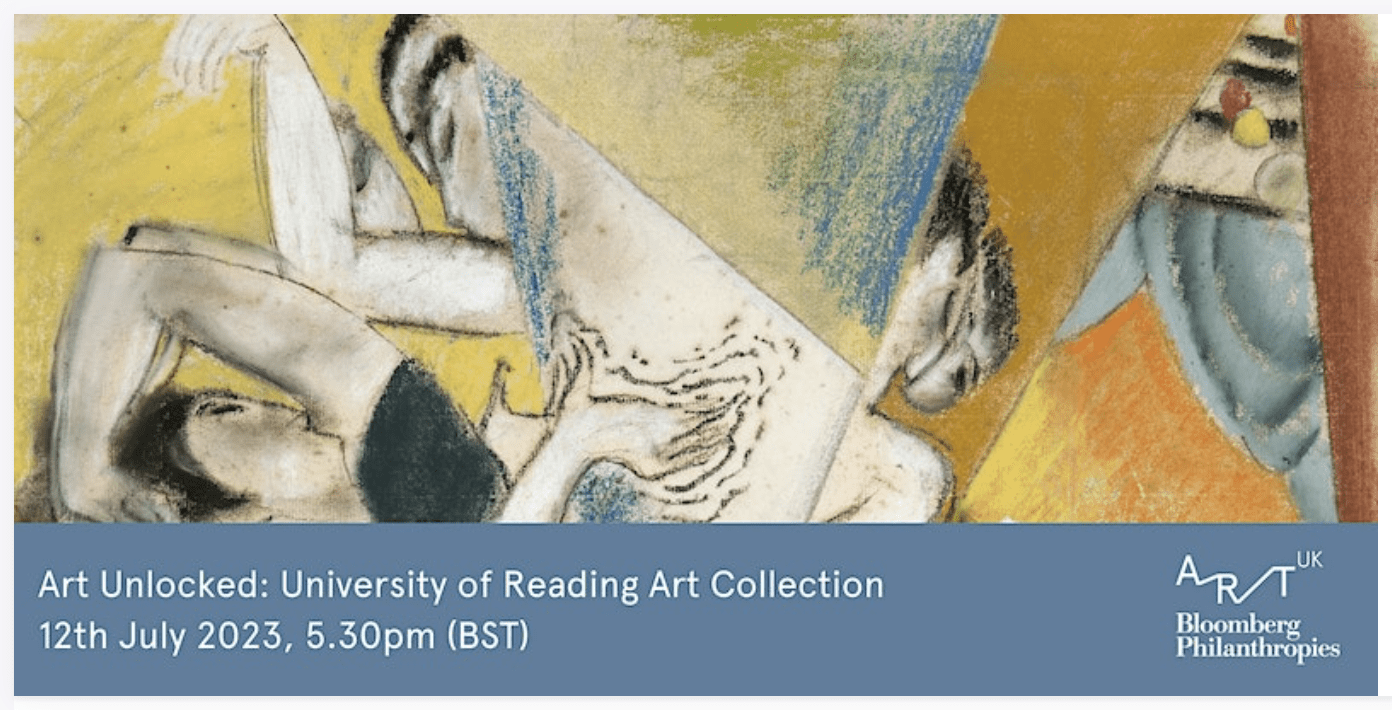
Flier for Dr Lyons’s presentation (image from the University of Reading Art Collection)

On Wednesday 12th July, Dr Hannah Lyons, Curator of Art at Reading University, gave a talk with the title ‘Art Unlocked: University of Reading Art Collection’. The presentation was hosted by Art UK in collaboration with Bloomberg Philanthropies.

screenshot
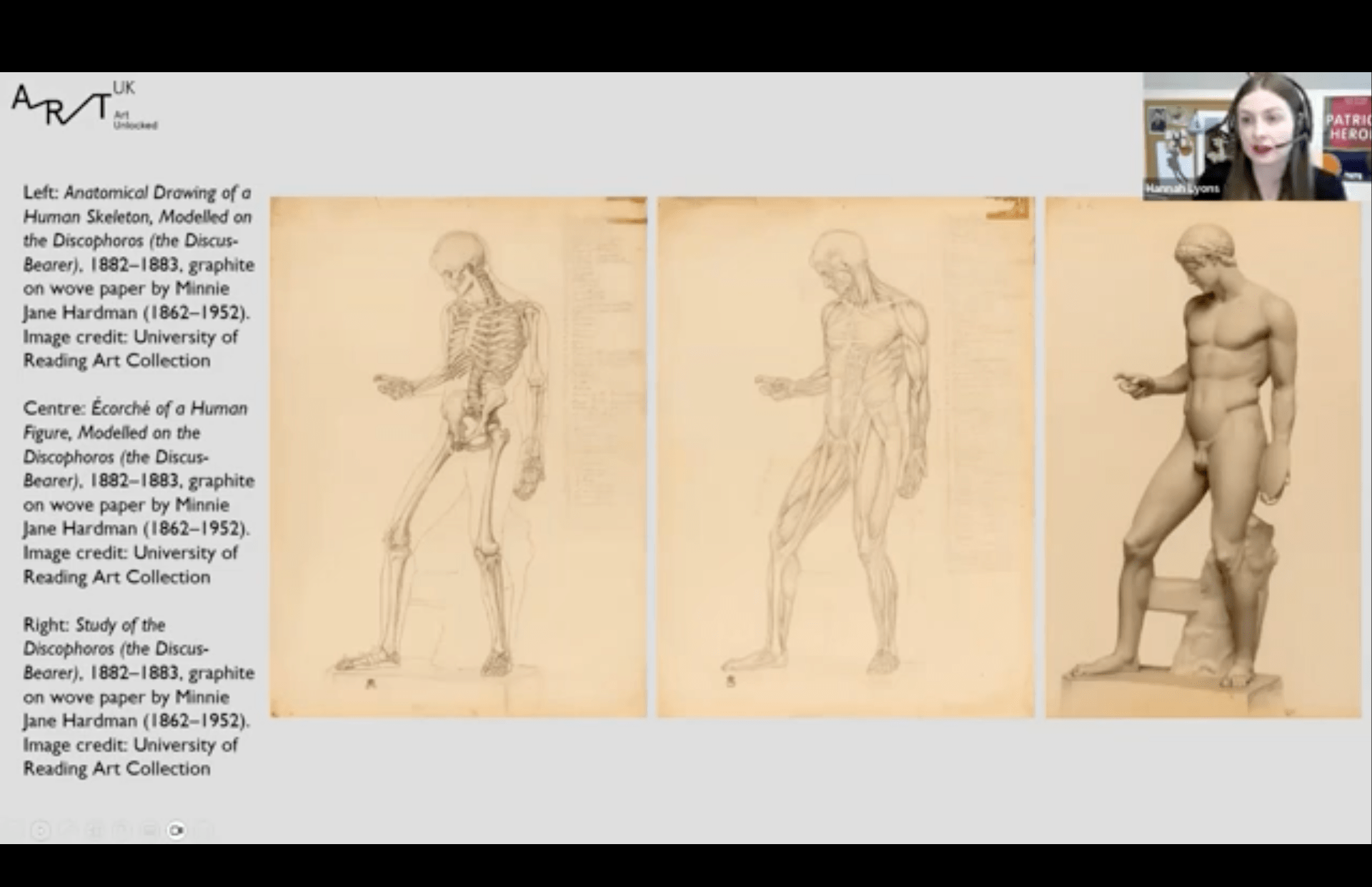
Anatomical drawings by Minnie Jane Hardman (University of Reading Art Collection)

During an analysis of the drawings of Minnie Jane Hardman (1862-1952), of which there are about 125 in the Reading collection, Dr Lyons pointed out that Hardman had enrolled at the Royal Academy of Art barely more than 20 years after first woman had been accepted there.

Laura Herford

The woman in question was Laura Herford (1831-1870) and she gained admission to the Royal Academy in 1860 by giving her name simply as L. Herford; it was assumed that she was a man.

The name Herford has previously appeared in four posts on this blog, and it occurred to me that Laura Herford might have been related to Caroline Herford who had been appointed to University College, Reading in 1909 as the College’s first Lecturer in Secondary Education.

John Herford(1789-1855) & Sara Smith Herford (c. 1818-1870)

To establish the family connection we need to go back to John Herford, a Coventry businessman who married the landscape artist and educationalist Sarah Smith Herford. They moved to Altrincham, Cheshire (now part of Trafford), in 1822 where Sarah founded the Unitarian Boarding School for Girls, and John set himself up as a wine and spirit wholesaler in Manchester. John appears to have had a varied career that also included stockbroking, insurance, pharmacy and membership of the Manchester Town Council.

Of their surviving children the most relevant here are William Henry Herford (1820-1908) (see below) and, of course, Laura Herford (1831-1870) who, as already noted, was the first woman to be enrolled at the Royal Academy of Art. Tragically, Sara died giving birth to Laura.

Another daughter of William and Sara was Mary Chance Herford, the mother of Helen Allingham a gifted watercolour painter. Thus, three generations of women (Sara Smith Herford, Laura Herford and Helen Allingham) achieved distinction as artists. Charles Herford, the nephew and biographer of William Herford commented thus:

‘…the distinguished career of Laura Herford (who first obtained the opening of the Academy Schools to women), and in the next generation, of her niece, Mrs. Allingham, indicate a strain of not inconsiderable artistic endowment in the family. (Herford, C. H., 1916, p. 30).

William Henry Herford (1820-1908

William, the older brother of Laura Herford, was an innovative educationalist and clergyman. He founded Lady Barn House School in Fallowfield, Manchester in 1873, a co-educational day school for pupils aged from seven to thirteen. William’s approach to running his school was strongly influenced by the ideas of Froebel and Pestalozzi. His espousal of co-education and experiential learning with the child at its centre was controversial at the time and produced shock in some quarters.

Herford
William Henry Herford, Brother of Laura and Father of Caroline (image obtained from Lady Barn House School)
Caroline Herford (1860-1945)

William Herford retired in 1886 at the age of 67 and passed on the headship to his second daughter Caroline who continued to run the school according to her father’s ideals.

This continued until 1907 when she gave up the headship to care for her father in his old age. A year after William’s death in 1908 she accepted the post of Lecturer in Secondary Education at University College, Reading.

C. Herford
Caroline Herford, daughter of William Henry Herford (image Courtesy of the Manchester Art Gallery)

So there is indeed a family connection between Caroline and Laura Herford; Caroline was Laura’s niece and the cousin of Helen Allingham.

Thanks

To Dr Hannah Lyons for permission to use the image from her presentation.

To Dan Slade, Deputy Head of Lady Barn House School, for information, documents and his Powerpoint presentations about the Herford family.

Sources

Dictionary of Unitarian & Universalist Biography: Brooke Herford.

Herford, C. H. (1916). A memoir of W. H. Herford. In W. H. Herford, The student’s Froebel (revised edition). Bath: Isaac Pitman.

Lady Barn House School website: https://www.ladybarnhouse.org/597/how-lady-barn-started

Sadler, M. E. (revised by Curthoys, M. C.) (2004). Herford, William Henry. Oxford Dictionary of National Biography. Oxford: OUP.