New acquisition: a collection of rare agricultural pamphlets

Written by Erika Delbecque, UMASCS Librarian

We are delighted to announce the purchase of a collection of twenty-two rare agricultural pamphlets from the mid-19th century. These works, which relate to the agricultural innovations and economics of this period, will enhance our existing collection strengths in British agricultural history.

drainagecover

A report of the discussion on drainage, 1848

The collection includes rare works on early applications of agricultural chemistry, studies of production and demand, and farmers’ reports on the use of new agricultural equipment. They provide a unique insight into the economic and technological developments in British agriculture in the mid-19th century, a pivotal period that marked the final stages of the British Agricultural Revolution.

Key innovations of this period that are represented include the improvement of agricultural drainage systems and the development of new fertilisers beside manure, such as guano (seabird excrement), sodium nitrates and potash. Another pamphlet promotes George Dollond’s “atmospheric recorder”, a type of weather station that records variations in air pressure, temperature, and humidity, for which he was awarded the council medal at the Great Exhibition of 1851.
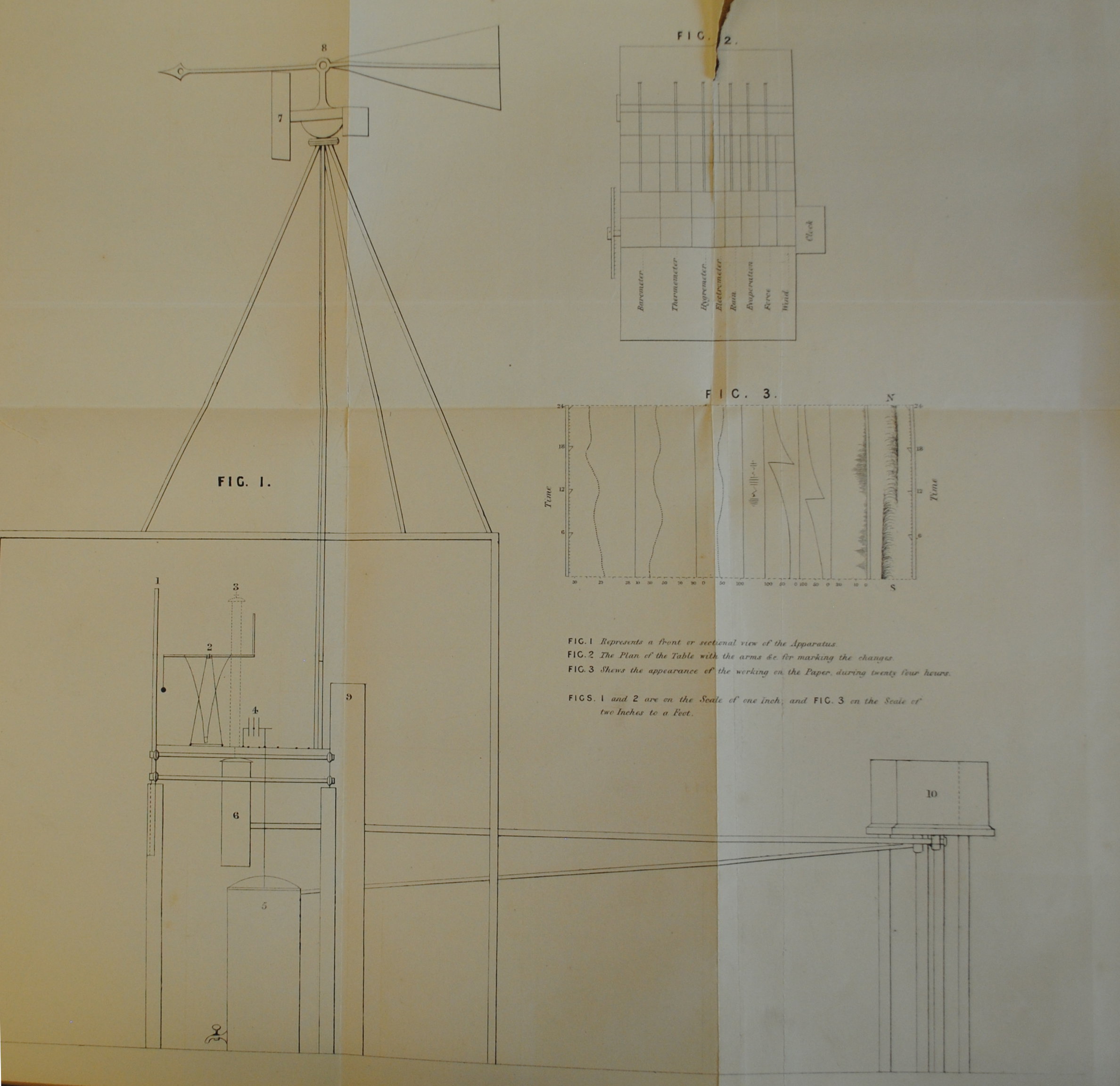
An engraved plate showing Dollond's atmospheric recorder, 1845

An engraved plate showing Dollond’s atmospheric recorder, 1845

Not all innovations were as successful. One pamphlet deals with the promotion of the alpaca as a profitable alternative to other breeding stock in England, claiming that the alpaca is “as fat as any sheep I ever saw” and that the animals “never ramble from their hill pasture”. In case alpacas are not of interest, the advertisers add that they also sell “turtle alive, or ready cooked and securely packed in jars”…

The Alpaca, with a wood-engraved illustration, 1844

The Alpaca, with a wood-engraved illustration, 1844

Most of the pamphlets were written by enthusiastic farmers or promoters of new farming methods and agricultural equipment. It was through cheap, often locally printed pamphlets such as these that farmers could keep on top of these developments. Therefore, pamphlets from this period are an important historical source for studying the dissemination of agricultural innovations.

These pamphlets were part of the collection of Sir Walter Gilbey (1831–1914), who was the president of the Royal Agricultural Society of England in the late nineteenth century. He donated his collection to the Society in 1896, where they remained until they were sold along with the rest of the RASE collections in 2014.

The pamphlets will now be processed and catalogued, and then join the rest of our extensive MERL book collections. The library and archives at the Museum of English Rural Life are recognised as one of the most important collections in the country for the study of the history of British agriculture, the countryside and rural society. All items can be consulted in our reading room.

This purchase was generously funded by the Arts Council England/Victoria and Albert Museum Purchase Grant Fund and the Friends of the National Libraries.
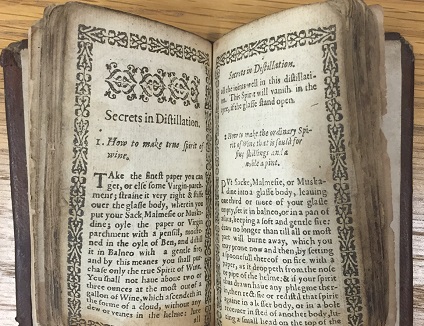
Delightes for Ladies

Written by Louise Cowan, Trainee Liaison Librarian

Originally published in 1602, ‘Delightes for Ladies’ by Sir Hugh Plat is one of the earliest cookery and

Delights for Ladies to Adorne their Persons, Tables, Closets, and Distilatories, 1628

Delights for Ladies to Adorne their Persons, Tables, Closets, and Distilatories, 1628

household recipe books produced in England.  It contains a fascinating array of recipes, instructions and advice on everything from making almond butter and preserving roast beef to creating candles for ladies tables and dying hair a lovely chestnut colour.

The little book was a perfect companion for the wealthy Elizabethan housewife who owned her own Still Room; a place in the house, usually linked to kitchen and garden, where the ‘still’ was kept for “the distillation of perfumes and cordials,” (Oxford Dictionaries), it was also where food was preserved and stored and where medicines, cosmetics and alcohol could be made.

The author began writing shortly after graduating from Cambridge University in 1572 (Plat, 1955), publishing a number of books which similarly offered advice and new ideas on the topics of agriculture, food preservation and gardening.  Plat’s ‘Delightes for Ladies’ however, was one of his most popular works, having at least thirteen editions produced before the middle of the seventeenth century (Plat, 1955).  The work was more recently reprinted in 1948 amidst post-war austerity by G.E. & K.R. Fussell with the hope that “we may be able to use some of the simpler and less recondite recipes for the zest they may add to our plain, wholesome diet.”

Although ‘Delightes for Ladies’ was often bound together with another similar work, ‘A Closet for Ladies and Gentlewomen, or the Art of preserving, conserving, and candying,’ believed by most to be by the same author, our edition contains only the ‘Delightes’.  The book itself features a poetical preface and is divided into four sections with the table of contents acting as an index.  The sections cover, ‘The Art of Preserving, conserving, candying, &c’; ‘Secrets in Distillation’; ‘Cookery and Huswifery’ and ‘Sweet Powders, Oyntments, Beauties, &c.’  Below are some of my favourite pieces of advice from the book:

A 29. To make gelly of Strawberries, Muberries, Raspisberries, or any such tender fruite.

Gelly of fruits

Gelly of fruits


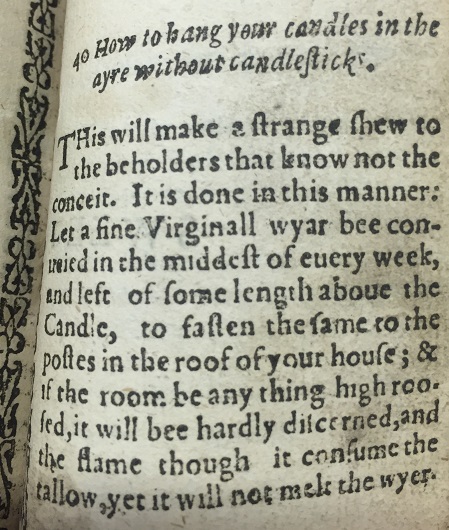
C.40 How to hang your candles in the aire without candlestick.

Candles hanging in the aire

Candles hanging in the aire


D.20 How to take away any pimple from the face.

Face full of heate, helped

Face full of heate, helped


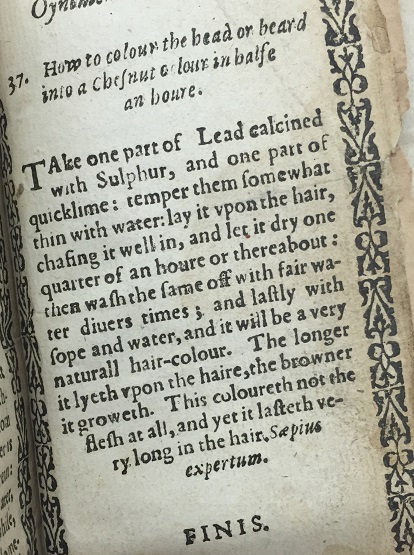
D. 37 How to colour the head or beard into a chestnut colour in halfe an houre.

Hair black altered

Hair black altered


It is probably best not to try some of these at home…

Sources

Plat, Hugh (1628) Delightes for Ladies to Adorne their Persons, Tables, Closets, and Distilatories with Beauties, Banquets, Perfumes and Water.  Read Practice, Censure. London: H.L and R.Y. [Stenton B/G27 – available upon request]

Plat, Hugh (1955) Delightes for Ladies. Reprint of Delightes for Ladies by Sir Hugh Plat, 1609.  Introductions by Fussell, G.E. and Fussell, K.R. (ed). London: Crosby Lockwood and Son LTD. [MERL LIBRARY NUPTO NH10 – available upon request]

Oxford Dictionaries (2016) http://www.oxforddictionaries.com/definition/english/still-room OUP.

Travel Thursday: John Todhunter Journal

Todhunter journal

Todhunter journal

Written by Louise Cowan, Trainee Liaison Librarian

John Todhunter (1839-1916) is best known as a poet and literary critic, but was also a doctor of medicine, painter, composer and traveller.

The University of Reading’s Special Collections Archive contains a fascinating Todhunter collection consisting of roughly 350 items including: personal and literary correspondence, (such as letters from John Butler Yeats, John Trivett Nettleship and William Michael Rossetti); typescripts and manuscripts of various literary works, and three travel journals.

One of these journals, titled ‘Journal of a Tour in Italy with D.L.T. 1880.’ details Todhunter’s travels in Italy with his new wife Dora Louisa.  In December 1879 the newlyweds had been recalled from an earlier trip in Florence as Todhunter’s father, Thomas, was taken ill.  After a rather “dismal winter” the couple were keen to escape back to Italy in the spring and their journey continued from March 1880 into the early autumn.  As might be expected, Todhunter’s journal contains notes on a plethora of typical tourist activities, such as his morning spent at Capitoline Hill in Rome,

Sat on steps, looked at wolves and Marcus Aurelius and then went into gallery.

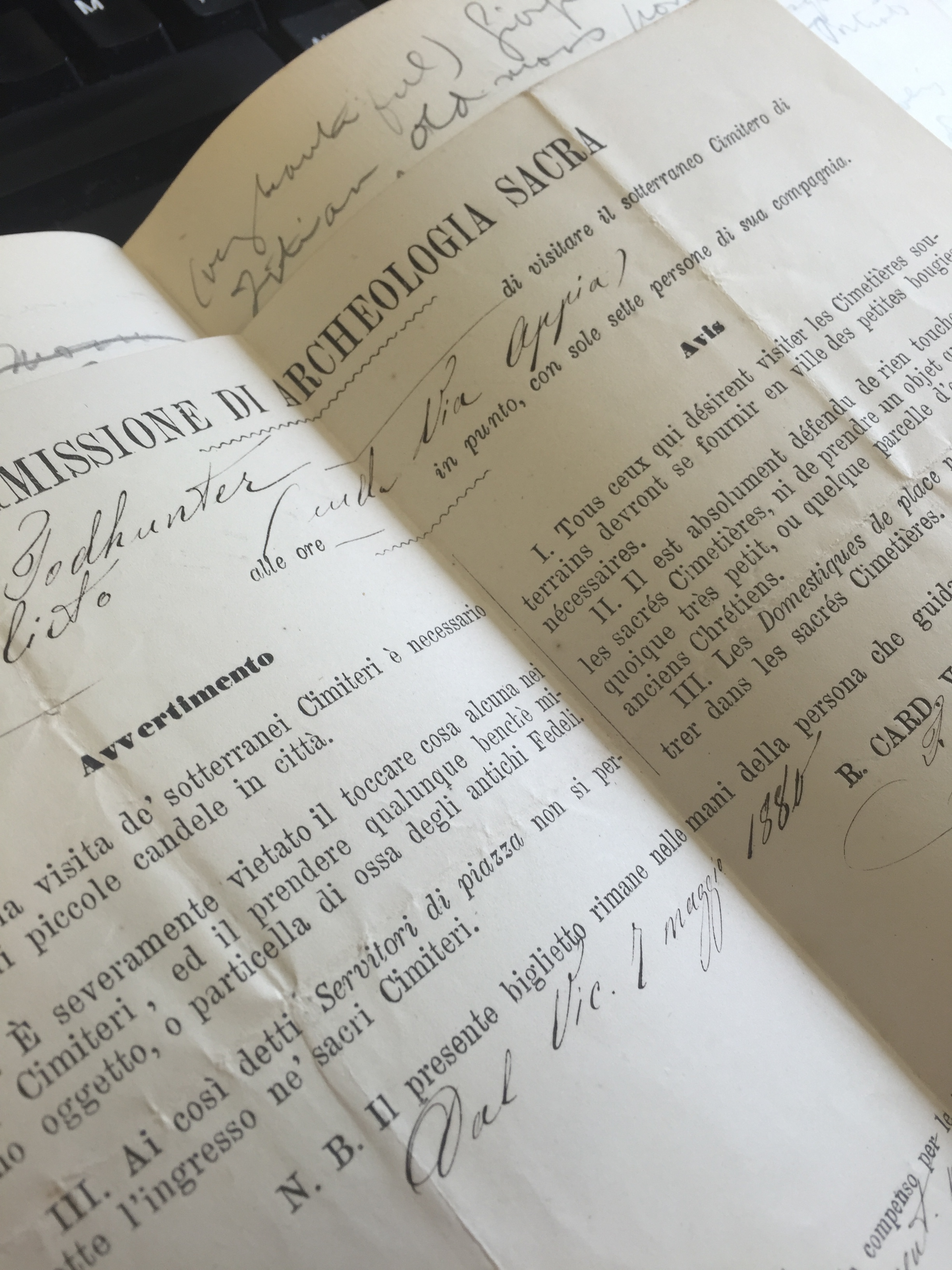
He lists his favourite pieces from the gallery as including the Capitoline Venus and a “very beautiful Penelope and Telemachus.”  There are moreover, several interesting pieces of travel ephemera, including tickets for visits to archaeological sites of interest, such as this entrance pass for a tour of the catacombs of Rome and the Appian Way:

Photo 11-05-2016, 14 49 19

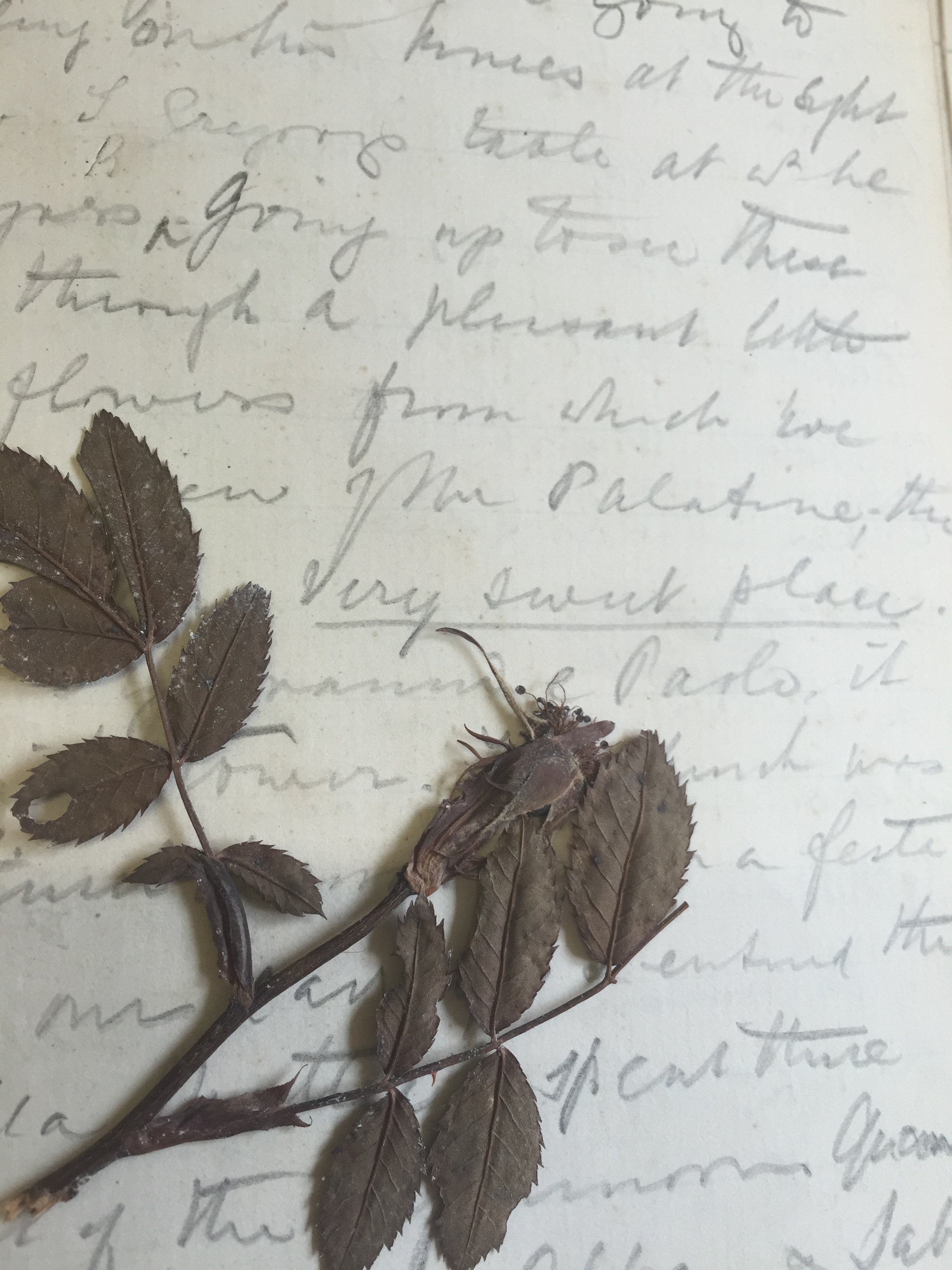
and a small collection of pressed plants.  One of these specimens was pressed between pages which mention a serendipitous walk through a garden in Rome.  Perhaps Todhunter kept the flower as a souvenir and reminder of the day:Photo 11-05-2016, 15 03 55

We went through a pleasant little garden full of flowers from which we had a splendid view of the Palatine, the best we had yet seen.  A very sweet place.

The travelogue also contains a number of fun anecdotes such as this note from Friday April 2nd:

We had found the caffe latte so bad that we resolved to take a foreign breakfast, and so had wine and an omelet.  Then to the Piazza del Durmo.

The entry for Wednesday May 12th is more celebratory as Todhunter notes it is his and Dora’s six month anniversary, an occassion they celebrated by going to a horse race ‘corsa dei cavalla’ in Rome.

Despite all of the interesting sights, pleasent gardens and new foods to experience, it is good to know that Todhunter did not forget his friends while travelling, on Monday April 26th he notes that he spent the morning “writing letters to Rossetti.”

You can find out more about the Todhunter Collection here, and how to access our archives here.

Archive Animals – Cats

Written by Louise Cowan, Trainee Liaison Librarian

Our Special Collections Library and Archive is full of interesting creatures, big and small.  They can be found everywhere from our Children’s Collection story books to the detailed scientific tomes of our Cole Library.  So far we’ve explored the Ducks, Horses and Bees but today is the turn of the graceful Cat. Here are just a few of my favourite titles on Cats from our collections:


Cats in Literature

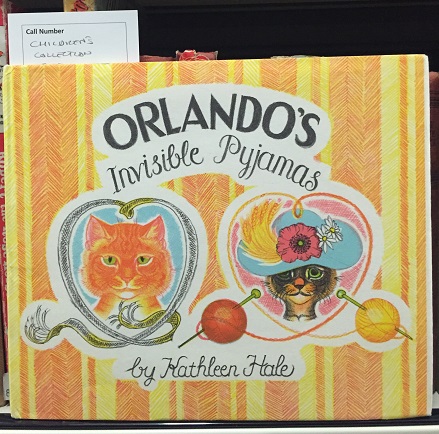
Orlando the Marmalade Cat – Kathleen Hale
[Children’s Collection 823.9-HAL]

This beautiful series of Children’s books created by Kathleen Hale feature the adventures of Orlando the

Orlando the Marmalade Cat, 1964

Orlando the Marmalade Cat, 1964

ginger cat, his wife Grace and their three kittens, Pansy, Blanche and Tinkle.

In ‘Orlando’s Invisible Pyjamas’ poor Orlando gets himself covered in paraffin oil, which makes him bald from waist to tail.  Grace manages to coax Orlando from hiding with the promise of knitting him some fur pyjama trousers.  While Grace knits, Orlando regales the kittens with stories from their family photo album.

According to MacCarthy (2000), Hale wrote to “reinvent a childhood, to recreate the domestic structure she had so badly lacked.”  And the bright story books with their tales of a tightly knit family of cats were a perfect distraction for children during WWII.  Indeed the bright colours of the ‘Orlando’ books are one of their best features; inspired by the series ‘Babar’ (Jean de Brunhoff), Hale had “envisaged a large format book in seven colours,” (MacCarthy, 2000) and although after some convincing from her publisher, only four were used, the effect is just as attractive.  After the publication of her first two Orlando books, Hale even learned the art of lithography herself, (Roberts, 2014) her efforts with the medium setting new standards for Children’s illustrated books.

As well as copies of a number of Hale’s books, our collection also includes archival material relating to their publication, such as uncorrected proofs of the text, holographs, typescripts and carbon typescripts.

For more information on Orlando see our 2007 featured item, Kathleen Hale, Orlando (The Marmalade Cat) buys a farm, 1972 

Sources:
Roberts, P. (2014) Orlando the Marmalade Cat
MacCarthy, F. (2000) Obituary: Kathleen Hale


Cats in Music and Art

Tabby Polka by Procida Bucalossi / Louis Wain
[Spellman Collection of Victorian Music Covers – Box 11]

This charming image comes from our Spellman Collection of Victorian Music covers, which consists of around 2,500 Victorian sheet music covers, illustrating virtually every aspect of Victorian life, culture

Tabby Polka [Spellman Collection]

Tabby Polka [Spellman Collection]

and preoccupations.

This particular piece, dating to c.1865 was composed by Procida Bucalossi (1832-1918), a theatre conductor and composer at the Prince of Wales’s Theatre, London who was known for his dance arrangements for the Savoy Operas. (Stone, 2001).

The artist behind the illustration is Louis Wain (1860-1939), a British artist renowned for his wonderful pictures of cats.  Later in life, Wain began to show signs of mental illness but continued to draw and paint.  His artwork however, took on an unusual quality and he “produced the first of his fascinating series of “kaleidoscope” cats,” which included intricate geometric patterns and “images in which the figure of the cat is exploded in a burst of geometric fragments.” (Boxer, 2016)

Sources:
Stone, D. (2001) THE D’OYLY CARTE OPERA COMPANY
Boxer, J. (2016) Louis Wain –  Henry Boxer Gallery 


Cats in Science

Celestial Atlas by Alexander Jamieson, 1822
[Reserve Middle Folio 523 JAM]

Felis - Celestial Atlas, 1822

Felis – Celestial Atlas, 1822

One of the many constellations described in “A Celestial Atlas” by Alexander Jamieson in 1822, Felis was composed by French astronomer Jerome de Lalande in 1799 from stars between Hydra and Argos Navis.  Sadly Felis did not make the list of 88 modern constellations when the IAU (International Astronomical Union) created an official set of constellation boundaries in 1930.

Sources:
International Astronomical Union, (2016) The Constellations
Ridpath, I. (2016) Felis the Cat


The Cat by St. George Mivart, 1881
[Cole Library 185]

Cat Paws - The Cat, 1881

Cat Paws – The Cat, 1881

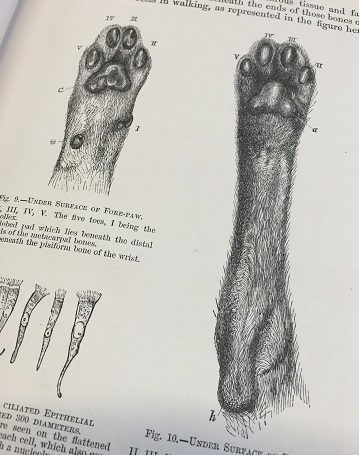
‘The Cat’ by British biologist St George Mivart is a fascinating, in-depth study of our feline friends.  The book provides highly detailed anatomical descriptions and illustrations, such as this of the cat’s paw:

Of these [pads of the feet] there are seven in the fore paw, and five in the hind paw.  Each pad consists of a mass of fibrous tissue and fat and a large trilobed one is placed beneath the ends of those bones on which the animal rests in walking.

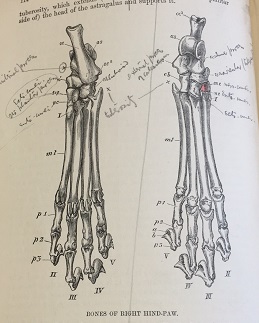
Many of the careful illustrations, particularly those of the cat’s muscles, have been coloured over and annotated, showing that the book was very much in use by its owner.

Annotated Cat Paws - The Cat, 1881

Annotated Cat Paws – The Cat, 1881

As well as anatomy, ‘The Cat’ also delves into the development and psychology of the cats, and one of my favourite features of the study are the small footnotes which include interesting anecdotes about the nature of the cat, such as this one from p369:

Mr Douglas A. Spalding found kittens to be imbued with an instinctive horror of dogs before they were able to see it.  He tells us: – “One day last month, after fondling my dog, I put my hand into a basket containing four blind kittens, three days old.  The smell my hand had carried with it set them puffing and spitting in the most comical fashion.” (Nature, October 7, 1875. P507)

gif of cat anatomy from Anatomie descriptive et comparative du chat by Hercule Straus-Durckheim, 1845. [Cole Large 09]

Anatomie descriptive et comparative du chat by Hercule Straus-Durckheim, 1845. [Cole Large 09]

All items are available upon request, find out more about using our Library and Archives here.

University of Reading Art Collections

Collections Audit


The University of Reading has an eclectic Art Collection. Artistic works are held within the University’s Special Collections, and within the University’s museums – including the Museum of English Rural Life.


History of the Art Collections

The Art Collections exist in parallel to the development of the University. Artworks reflect the University’s institutional history and act as a reference to its teaching practices. The collection includes work by previous staff and students, providing tangible links to the earlier School of Art and the University Extension College. More recently, artworks represent the interests of individuals and departments who have contributed to the collection – acquisition was often the result of idiosyncratic benefaction.

Notable Works

A number of significant artists are represented. This includes: Camden Town Group member Walter Sickert, printmaker Stephen Buckley, painter Patrick Caulfield, surrealist and poet Julian Trevelyan, figurative painter Leon Kossoff, Isotype pictogram designer Gerd Arntz, master of the woodcut Allen W. Seaby, cubist Max Weber, engraver Stanley Anderson, abstract photographer Alvin Langdon Coburn, renowned naturalist painter Charles Tunnicliffe, 17th century Baroque artist Peter Paul Rubens, and many others.

The Art Collections comprise a series of distinct collections, each with its own focus and trajectory:


  • Historic Picture Loan Scheme

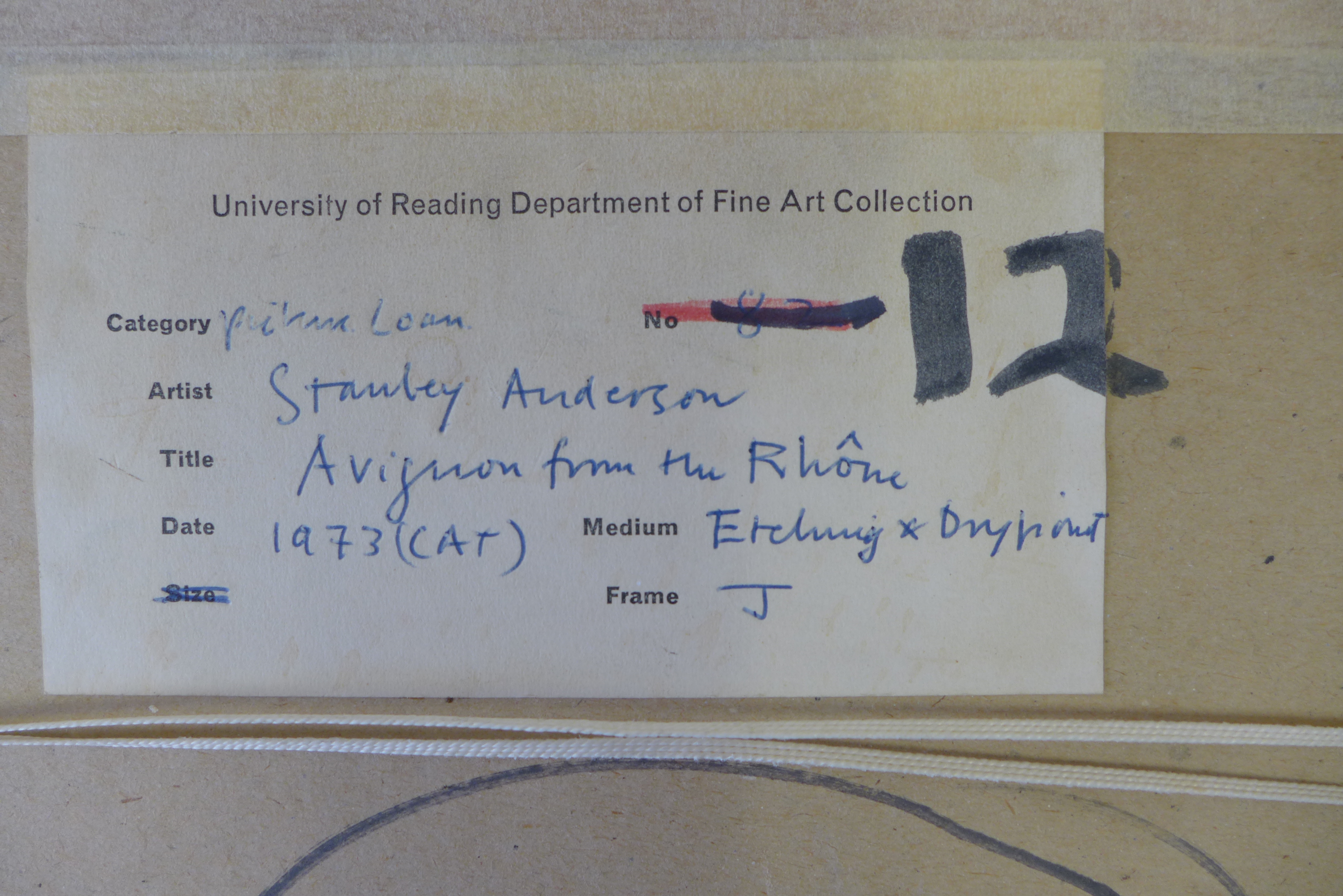
Now defunct, the Picture Loan Scheme was administered by the Fine Art Department. It lent artworks to University patrons on an annual basis, for a nominal fee. The collection includes paintings and works on paper. The scope of the collection is impressive; it contains examples of printmaking practice from important artists – including numerous signed artist proofs.

Historic Picture Loan Scheme label

Historic Picture Loan Scheme label

  • Betts Collection: Sickert Drawings

Professor Anthony Betts was the University’s first Professor of Fine Art. Betts was instrumental in the establishment of an Honours Degree course in Fine Art in 1937. The Betts collection was amassed by Betts himself and later expanded through the acquisition of work from his estate. It contains a collection of works on paper of international importance by Walter Sickert.

Walter Sickert, The Little Bed, 1902

Walter Sickert, The Little Bed, 1902

  • Betts Collection: Master Drawings

A small but noteworthy collection of drawings by artists including Peter Paul Rubens, James Abbott McNeill Whistler and Frederick Spencer Gore.

Max Weber, Dancing Figures, 1912

Max Weber, Dancing Figures, 1912

  • Betts Archive

The archive contains artworks, preparatory work and teaching aids produced by Professor Betts and his colleague Cyril Pearce, a lecturer in Design & Composition.

Betts Archive: woodcut prints by Prof Betts

Betts Archive: woodcut prints by Prof Betts

  • Minnie Jane Hardman (nee Shubrook) Collection

Minnie Hardman (nee Shubrook) was a female student at the Royal Academy in the late 19th century. Unrivalled in its ability to document her experience, the collection records the work she undertook as a young adult.  It includes examinations on perspective, anatomical and life drawings, as well as examples of her superb sketches and stippling – many of which were awarded prizes by the Academy.

Shubrook/Hardman Archive

Shubrook/Hardman Archive

  • Paintings

The collection contains commissioned portraits of Chancellors and people of merit associated with the University. This includes portraits of members of the Palmer family, who continue to support the University.  There are a number of historic and contemporary views of Whiteknights Park, including 19th century landscapes by Thomas Christopher Hofland. Attributed as being America’s first cubist painter, the collection includes 15 canvases by Max Weber.  Among others, the collection contains work by 20th century painters Alan Lowndes, John Randall Bratby and Leon Kossoff.

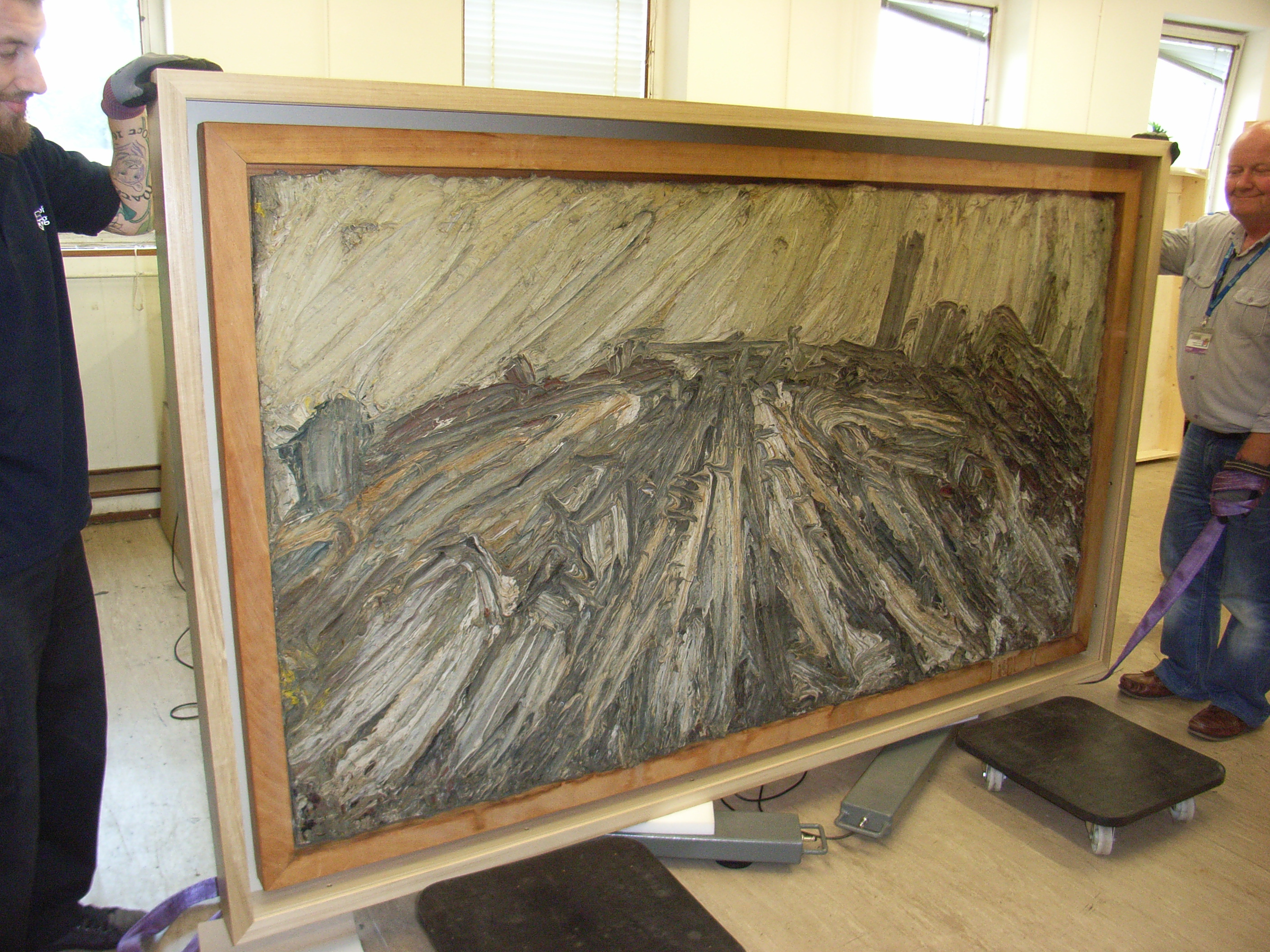
Leon Kossoff, Wilesden Junction Early Morning, 1962

Leon Kossoff, Wilesden Junction Early Morning, 1962

Due to the nature of artistic works and their inability to be defined effectively by a single collection, artistic works appear across UMASCS.  Noteworthy bodies of artworks include:


  • Ladybird Artwork Archive (Special Collections)

The University of Reading cares for over 700 boxes of original artwork used to illustrate Ladybird children’s books. The iconic paintings contributed to the success of the books in raising literacy levels among British children in the 1950s-1970s. The collection includes iconic artwork such as Harry Wingfield’s Shopping with Mother.

Ladybird pop-up display © Ladybird Books Ltd

Ladybird pop-up display © Ladybird Books Ltd

  • Livestock Portraiture (Museum of English Rural Life)

A collection of 18th and19th century Livestock Portraiture, including prints and oil paintings. The images are a historical record, which document the process of English livestock improvement. Artworks capture the physiological changes that are the result of early attempts at selective breeding by pioneering farmers.

MERL Livestock Portraiture 64/104

MERL Livestock Portraiture 64/104

2016 Project

This year, and moving forwards, the University is committed to the development of the Art Collections.  The University is addressing numerous collections management issues and hoping to build the profile of the Art Collections for a wider community of users, through a series of engagement activities.  The project aims to achieve a number of things, the work involves:

  • Auditing the collection and retrospectively cataloguing individual artworks on the Adlib collections database
  • Digitising artworks and making the collection accessible online,  via the University’s Enterprise catalogue and the ARTUK website
  • Improving the physical care of artworks through a programme of remedial conservation and preventative conservation, such as re-framing and improving storage conditions
  • Providing access to the collections through a series of pop-up displays, a programme of lunch-time talks ‘Art Collections in Conversation’, and taking part in University events such as the Collections Fair and Engagement Week. Inviting students and researchers to access material in the Reading Room and encouraging the use of the collections within teaching & learning. Using the Art Collections to enhance Artist Residency programmes.
  • Displaying artworks within the new galleries at MERL as part of the Our Country Lives redevelopment project (opening October 2016), displaying artworks within the new Ladybird Gallery (opening October 2016) and displaying artworks in temporary display spaces around campus such as the 2016 Christmas Display in the Staircase Hall. Improving and installing permanent interpretation of artworks around the University campus.
  • The project also supports the training and development of three young volunteers.


If you have any questions about the Art Collections please contact Jacqueline Winston-Silk j.winston-silk@reading.ac.uk and follow our progress on Twitter @UniRdg_ArtCol


Cataloguing Cole: Fishes, Photographs and the Forces

Written by Sharon Maxwell, Archivist (Cataloguing & Projects)

Some of the original packaging used by Cole to house his archive

Some of the original packaging used by Cole to house his archive

I have recently been cataloguing the personal papers of Professor Francis J Cole, (1872-1959), the first Professor of Zoology at the University of Reading. The fascinating papers in the Cole collection include research for his academic writings and publications, bibliographies and indexes relating to his library and his bibliographic studies and photographic material including thousands of glass negatives and lantern slides used by Cole in his teaching.  Cataloguing this material has given me an insight into Cole’s research methods and his interests.

Cole was born in London, England on 3 February 1872. On leaving school Cole’s aim was to go to Oxford and read zoology. He learnt zoology at the Royal College of Science, and he also attended lectures at the Royal Institution and studied at Christ Church, Oxford and the University of Edinburgh.  In 1894 he was appointed lecturer in zoology at Liverpool University College, later the University of Liverpool.  He stayed there for twelve years and combined work during term time at Liverpool with research during vacation at Jesus College, Oxford.  In this way he obtained a B.Sc.

In later years Cole re-used many of his old College notebooks to record his research notes, examples of which can be seen here, alongside a photograph of Professor Cole taken in 1939 (MS 5315/2/2)

In later years Cole re-used many of his old College notebooks to record his research notes, examples of which can be seen here, alongside a photograph of Professor Cole taken in 1939 (MS 5315/2/2)degree at Oxford by research in 1905.

degree at Oxford by research in 1905. In 1906 Cole took up an appointment as lecturer in zoology at University College, Reading, and in the following year became the first occupant of the chair of zoology, which he held until his retirement in 1939.  In these thirty-two years he built up a flourishing department, founded a Museum of Comparative Anatomy which is now called by his name, and collected a magnificent library of early works on medicine and comparative anatomy.


He was awarded the Rolleston Prize at Oxford in 1902 for his researches on the cranial nerves of fishes, Chimaera.  Later he published a series of papers on the myxinoid fishes and received the Neill Gold Medal and Prize of the Royal Society of Edinburgh in 1908.  His D. Sc., Oxford, followed in 1910. During World War I he was commissioned in the 4th Territorial Battalion

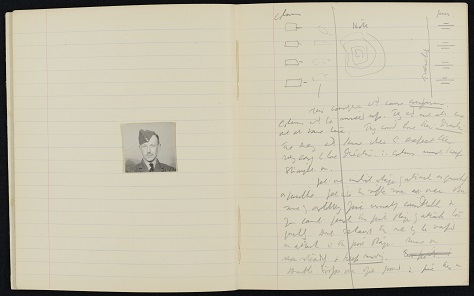
A small image of Professor Cole in his uniform and a notebook he used to record notes for his work with his Battalion on the east coast during WWI, you can see his diagram detailing positions and trenches

A small image of Professor Cole in his uniform and a notebook he used to record notes for his work with his Battalion on the east coast during WWI, you can see his diagram detailing positions and trenches

of the Essex Regiment and was stationed on the east coast in charge of a coastal gun emplacement.


Cole’s detailed notes and transcriptions of each letter written by Leeuwenhoek

Cole’s detailed notes and transcriptions of each letter written by Leeuwenhoek

Returning to Reading after the war Cole turned more and more to the history of biology. His collection includes research for many of his major publications on this subject, including the zoological researches of Antony van Leeuwenhoek (1632–1723), and his history of comparative anatomy.

The material that has survived in Cole’s archive gives you an insight into his style of research, he liked to produce detailed indexes to sources that he used, which refer you to material within his own library and to sources he found in other libraries and museums, so that you can closely follow his research path.  He also took great care with the illustrations produced to accompany his published writings, drawing many of the original images himself and annotating proofs until they were perfect for publication.

Proofs and original drawings by Cole for his study on the nerves and sense organs of fishes, (MS 5315/1/2)

Proofs and original drawings by Cole for his study on the nerves and sense organs of fishes, (MS 5315/1/2)


Cole clearly liked to enliven his lectures and talks, and his collection includes thousands of glass

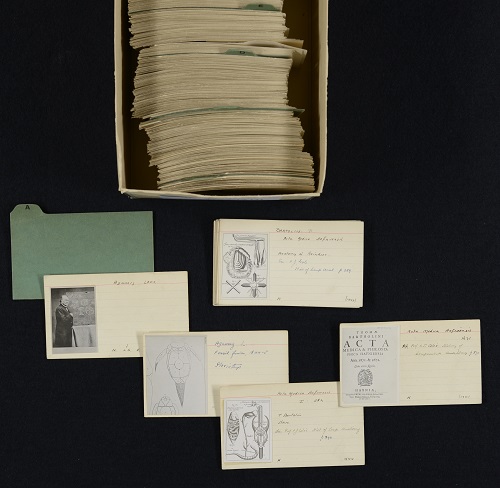
Index cards created by Cole to keep track of his vast collection of glass negatives, (MS 5315/3/14)

Index cards created by Cole to keep track of his vast collection of glass negatives, (MS 5315/3/14)

negatives and lantern slides.  Ceri, our Reading Room Assistant is currently cataloguing these images and each negative will soon be digitised so that an image of the negative will appear alongside its catalogue description. Our volunteers Ron and Jan are carefully re-packaging these items into acid-free covers and boxes to preserve them for the future.

Professor Cole’s papers are available for research in the reading room, reference MS 5315 and the glass negatives will be available to view on our online catalogue in the near future.


Sources and further reading:

Much of the biographical information above was taken from an article written by N.B. Eales in the Journal of the History of Medicine and Allied Sciences 1959, Vol. XIV, No. 1

See also the Cole Library and the Cole Museum for further insight into Professor Cole’s collections

Travel Thursday – Great Western Railway

Written by Louise Cowan, Trainee Liaison Librarian

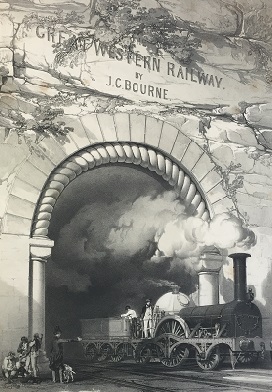
Title page of 'The History and Description of the Great Western Railway' by J. C. Bourne - 1846

‘The History and Description of the Great Western Railway’ by J. C. Bourne – 1846

The Great Western Railway (GWR) was founded in 1833 and received an enabling Act of Parliament in August 1835 that allowed the company to provide a double tracked line from Bristol to London (Daniel, 2013).

Five years ago, no man had ever travelled from London to Bristol, even by the mail in much less than twelve hours; upon the opening of the railway the distance was performed in four hours 

(Bourne, 1846)

Isambard Kingdom Brunel was appointed as the project’s engineer, determining the route, sections and estimates (Bailey, 2006).  He also designed a controversial broad gauge track in an effort to increase speeds and passenger comfort (Daniels, 2013).

Construction of the line finally began in 1836; initial stages saw work being completed between Bristol and Bath in the West, and Reading and London in the East with connecting lines and stations quickly following. (Daniels, 2013).  Upon completion in 1841, the GWR was considered such an outstanding achievement that it was dubbed ‘God’s Wonderful Railway’ by many (Trueman, 2016) and in 1846 John C. Bourne published “The History and Description of the Great Western Railway” with the express purpose of highlighting, the “constructive skill and general grandeur of appearance,” of the project.

Bourne’s work is a fascinating insight into an exciting period in the history of transport and travel; it gives a brief history of the political and economical challenges faced by the GWR, an overview of the scientific and engineering principles involved in the construction of railways and locomotives, and then presents an array of beautiful lithographs highlighting the remarkable construction and architectural work found along the tracks.

but the straightness of a railway, and the rapidity of the motion upon it, entirely shut out its far greater and more numerous works, and thus some of the most magnificent structures in the kingdom, though crossed daily by thousands, are actually seen by few.

(Bourne, 1846)

Highlights from among the lithographs include:

Paddington Station, London (Bourne, 1846)

Paddington Station, London (Bourne, 1846)

An early Paddington Station, the London terminus of the railway designed by Isambard Kingdom Brunel.

The railway leaves Paddington in cutting, but the Kensal-Green Cemetery, with its glittering temple, is seen on the right, and on the left an occasional view of the Vale of the Thames.

(Bourne, 1846)


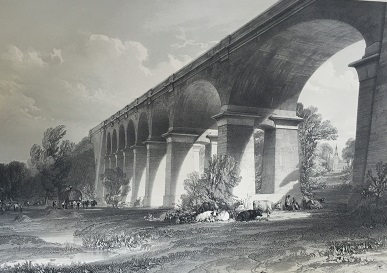
The Wharncliffe Viaduct (Bourne, 1846)

The Wharncliffe Viaduct (Bourne, 1846)

The Wharncliffe Viaduct, the largest piece of brickwork along the railway and one of the first pieces of work to be complete.

The arches are elliptical, eight in number: the span of each is seventy feet, and the rise seventeen feet six inches.  The piers are composed each of two square massive pillars of brick, slightly pyramidal, and of a character somewhat Egyptian.

(Bourne, 1846)


The Engine House, Swindon (Bourne, 1846)

The Engine House, Swindon (Bourne, 1846)

The engine house at Swindon, which gives an interesting behind the scenes look into the operations of the GWR:

[It is]capable of accommodating about a hundred engines: these consist of the engines in actual use, of the stock of spare engines, and of those undergoing repair.  At this station every train changes its engine, so that from this circumstance alone, at least twice as many engines are kept here as at any other part of the line.

(Bourne, 1846)


By 1842, GWR and two other railways owned by the company had over 170 miles of line and in that year, conveyed 869, 444 passengers without a single casualty.


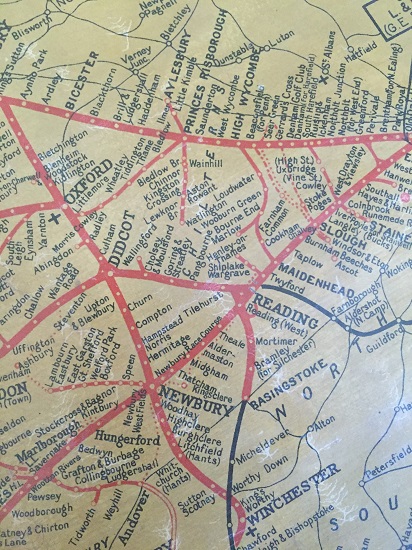
Great Western Railway Map

Great Western Railway Map

This fantastic map from our Eynsham Park Estate archive shows the

Detail of the Great Western Railway Map showing lines near Reading

Detail of the Great Western Railway Map showing lines near Reading

success of GWR roughly sixty-eight years later.  Lithographed by the well-respected W. & A.K. Johnston Ltd, and designed to be hung on the wall, the map highlights the reach of the GWR across the South of England with the red lines indicating GWR’s main lines, branch lines and running powers.


Great Western Railway Ticket designed by De la Rue.

Great Western Railway Ticket designed by De la Rue.

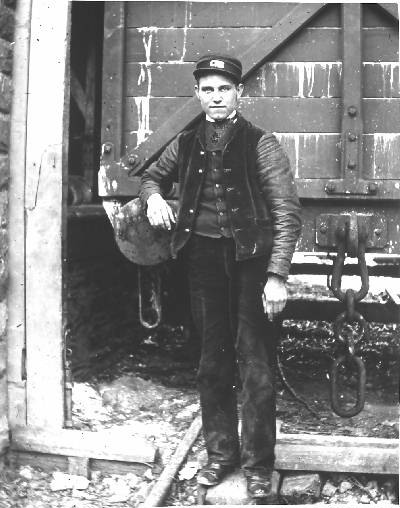
Our archives hold a number of other fascinating pieces of GWR ephemera including some beautiful photographs of Reading Station (c.1880 – 1930s), portraits of Railway Workers, and this lovely blank specimen of a season ticket printed by De la Rue c.1930.


  a work of mechanical art represents the united efforts of many generations

(Bourne, 1846)

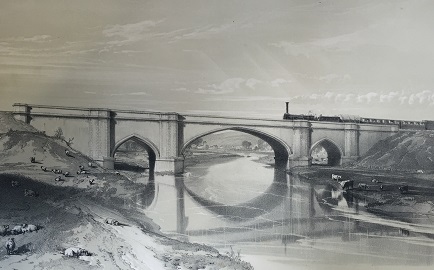
Bridge Over the River Avon (Bourne, 1846)

Bridge Over the River Avon (Bourne, 1846)

You can find more on the Great Western Railway from our collections here  and information on accessing our archives here.


Sources and further reading:

Bailey, M. R. (2006) Briefing: I. K. Brunel: Engineer of the Great Western Railway. Proceedings of the Institution of Civil Engineers – Transport 2006 159:2, 57-61

Bourne, J. C. (1846) The History and Description of the Great Western Railway. London: David Bogue [Reserve Large Folio 47 – Available upon request]

Daniel, John (2013) Great Western history, 1835 – 1892.

Trueman, C.N. (2016) Trains 1830 To 1900.

An A-Z of the University’s Museums and Collections

@52Museums Instaphabet

@52Museums Instaphabet

Earlier this month the University of Reading’s Museums and Collections collaborated on an exciting project for @52Museums on Instagram.  The 52 Museums programme, which began in January 2016, sees a new museum taking over the running of the 52 Museums Instagram and Twitter page each week in order to share their collections, exhibitions, achievements and more with the world.

To best showcase our fantastic range of collections we produced an A-Z guide or ‘instaphabet’ featuring lettering from our Typography collection and Special Collections Library alongside art, artefacts and anecdotes from the Museum of English Rural Life, Cole Museum of Zoology, URE Museum of Greek Archaeology, our Herbarium, Art collection and Volunteers.

Some of the highlights from the Special Collections Library and Archive include:

Di - De la RueD is for De la Rue
The De la Rue printing firm was founded in Bunhill Row, London in 1837. It manufactured Christmas and other social stationery, playing cards, stamps and railway tickets, and undertook security printing.
Our collection consists of correspondence, financial papers, designs and specimens from the period 1837-1965; including designs for Reading’s famous Huntley and Palmers Biscuit Company.


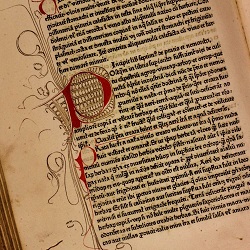
Ri - Ruralia commoda - Ptrus de CrescentiusR is for Ruralia Commoda
The Ruralia commoda is the oldest printed book in our rare book collections. Written by Petrus de Crescentius in 1471, it is an early agricultural manual, and is said by some to have been the most important original medieval work on agriculture, husbandry and horticulture.


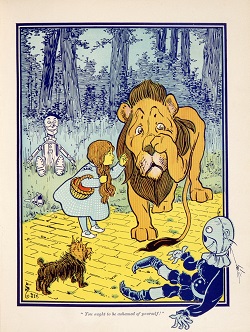
Yi - Yellow Brick RoadY is for Yellow Brick Road
This beautiful illustration of the Yellow Brick Road by W.W. Denslow is from our 1st edition copy of ‘The wonderful wizard of Oz’ by L. Frank Baum (1900). Our Special Collections Library is home to a fantastic Wizard of Oz collection, comprising around 800 volumes, including many editions and translations of The Wizard of Oz, and other associated items.


See our full #instaphabet in all its glory on Instagram!

Archive or Objects: Cataloguing Ladybird Artwork

Written by Clare Plascow, Collections Officer

How do you catalogue an artwork? That is the question I’ve been trying to solve over the last few days. Usually the answer would be simple…it would be added to the Art Collection area of the University of Reading’s Collections Management System (CMS). Complicating the matter, however, is the fact that this artwork is not just a ‘normal’ painting instead it is part of the Ladybird Artwork Archive which includes 700 boxes of original art used to illustrate hundreds of books.

IMG_1429

A few boxes in storage … with many more out of shot

Individually painted and beautifully detailed, by commercial artists who specialised in different styles, these artworks were instrumental in depicting the clear message of the Ladybird books and partially the reason for their continued popularity. Ironically the familiar pocket-sized books only started to be produced around 25 years after Wills & Hepworth first started printing the inexpensive Ladybird books in 1914 in runs between their main commercial jobs. It was also by necessity rather than design, with paper shortages during the Second World War creating a rethink in the formatting which allowed a book of 56 pages to be printed on a single sheet of 40 by 30 inch paper.

MS 5336_634_24

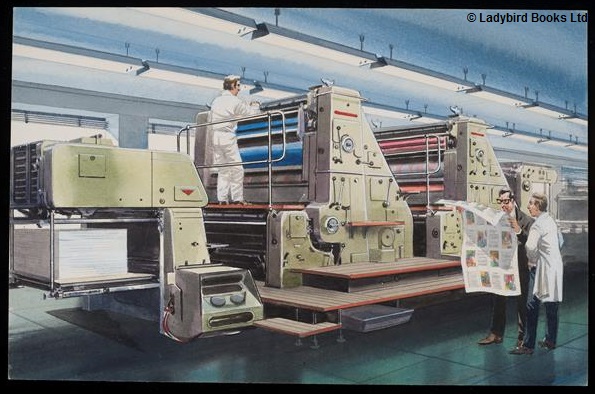
One of the printing presses used to print Ladybird books. Illustration from The Story of Printing, A Ladybird ‘Achievement’ book by David Carey, illustrated by Robert Ayton.

Covering a huge variety of subjects with educational and informative content, Ladybird books offered young readers the opportunity to pursue knowledge themselves. Ladybird capitalised on their user-friendly layout with full page illustrations to develop literary, publishing both the Key Words Reading Scheme and Learning to Read series, which were often used to teach children how to read in the 1950s to 1970s.

MS 5336_375_23

How many milk bottles? Illustration from Numbers, A Ladybird ‘Learning to Read’ Book by Margaret Gagg, illustrated by G. Robinson.

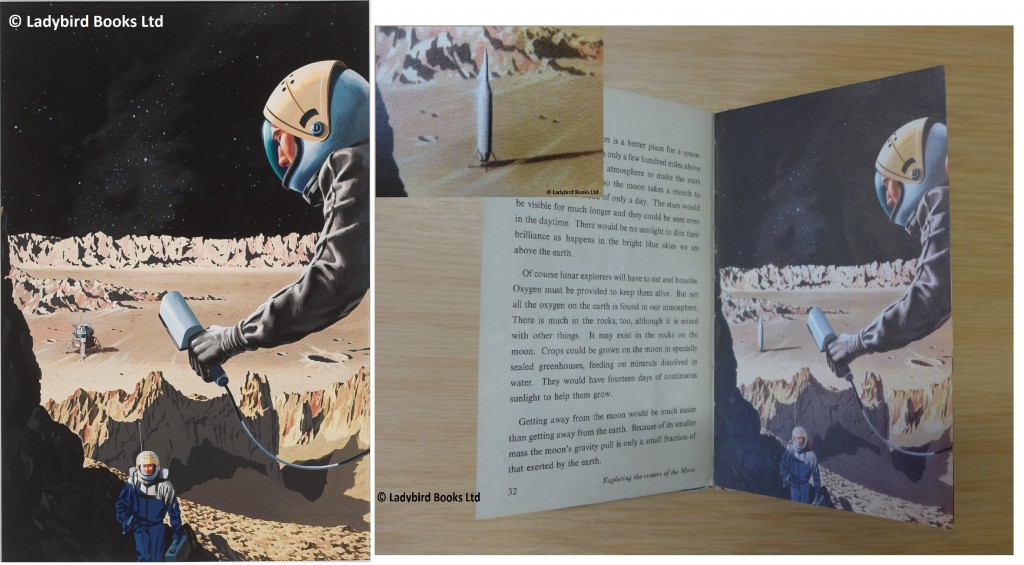
Adding to the complexity involved in cataloguing this artwork, Ladybird did not reproduce new versions of the art required for updated publications instead the original paintings would either be reused or if necessary be carefully modified. This means that a single work could have appeared in several different versions of a book which can create problems in hierarchies used by Archives. The method of revising paintings can be seen in this print from Exploring Space where a close-up shows an earlier outline of the lunar module from before the 1969 Moon landing.

MAIN_IMAGE_MS 5336_384_15_with credit line

Astronauts exploring craters on the Moon. Illustration from the revised edition of Exploring Space, A Ladybird ‘Achievements’ Book by Roy Worvill, illustrated by Brian Knight and Bernard H. Robinson.

Held by the University of Reading on behalf of Penguin Random House, the Ladybird Artwork Archive has actually been catalogued previously…but only to box level. This gives us a really good overview of what is held in the collection but we now want to delve deeper to record individual works.

MS 5336_3_14

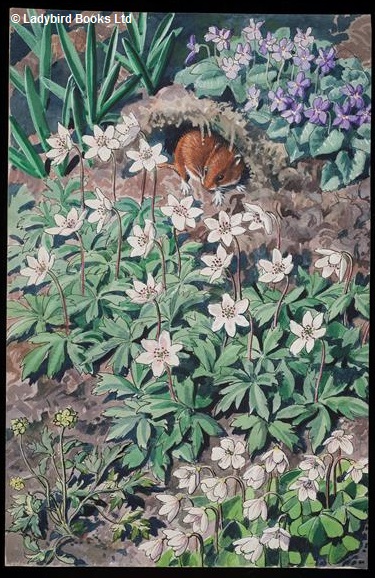
A bank vole. Illustration from What to look for in Spring, A Ladybird ‘Nature’ Book by E.L. Grant Watson, illustrated by Charles Tunnicliffe.

So why catalogue them now? With the redevelopment of the Museum of English Rural Life, a space to display some of this artwork has been created so we are now able to share objects from this amazing archive. Several prints from this collection have also been sent to other museums and galleries on loan to temporary exhibitions. This means that we have needed to record more information about the original artworks as they have been sent out, but this has been as needed and it makes sense to us that we catalogue the entire collection. With each work being recorded, links will need to be made to the original book and any revised editions, as well as to the different publication series.

MS 5336_101_24

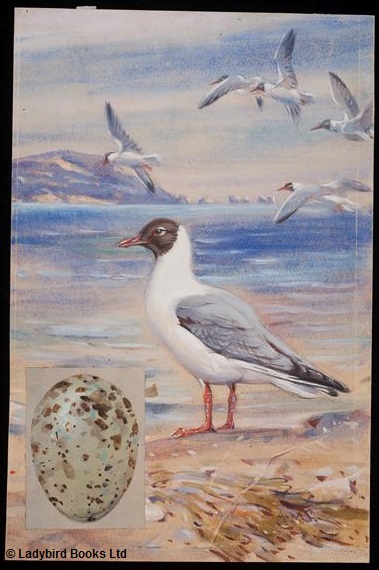
The black-headed gull. Illustration from British Birds and their Nests, A Ladybird ‘Nature’ Book by Brian Vesey-Fitzgerald, illustrated by Allen W. Seaby.

Considering that each box holds anywhere from 20 to 50 items it’s a lot of catalogue so I want to make sure that I get it right first time. Which leads me right back to my original dilemma … Object or Archive?

Discover our collection strengths – new Special Collections web pages

Written by Fiona Melhuish, UMASCS Librarian

A new set of web pages for the Special Collections website is in production to help researchers discover more about our collection strengths. The new pages will provide more thematic entry points into our collections, and hopefully encourage a more integrated, cross-collection exploration of the University’s resources which will help researchers make the most of our collections.

To browse the index of pages, go to our home page and either click on ‘Explore our collection strengths’ on the main page or click on ‘Collection strengths’ under the ‘Collections’ tab on the left-hand menu as indicated below:

SC homepage


Collections strengths page


In addition to an existing page on authors’ and writers’ papers, two further pages have been published, one on book history and another on children’s books [see below], with more to follow on themes such as business history, literature and art of the 1890s, the First and Second World Wars, and science, medicine and mathematics, so watch this space!

If you have any comments or suggestions to make about these pages, please let us know.


Childrens books web page