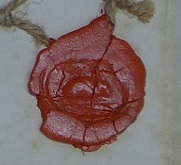
William Wordsworth: A letter to Longman, 1820

Written by Adam Lines, Reading Room Supervisor.
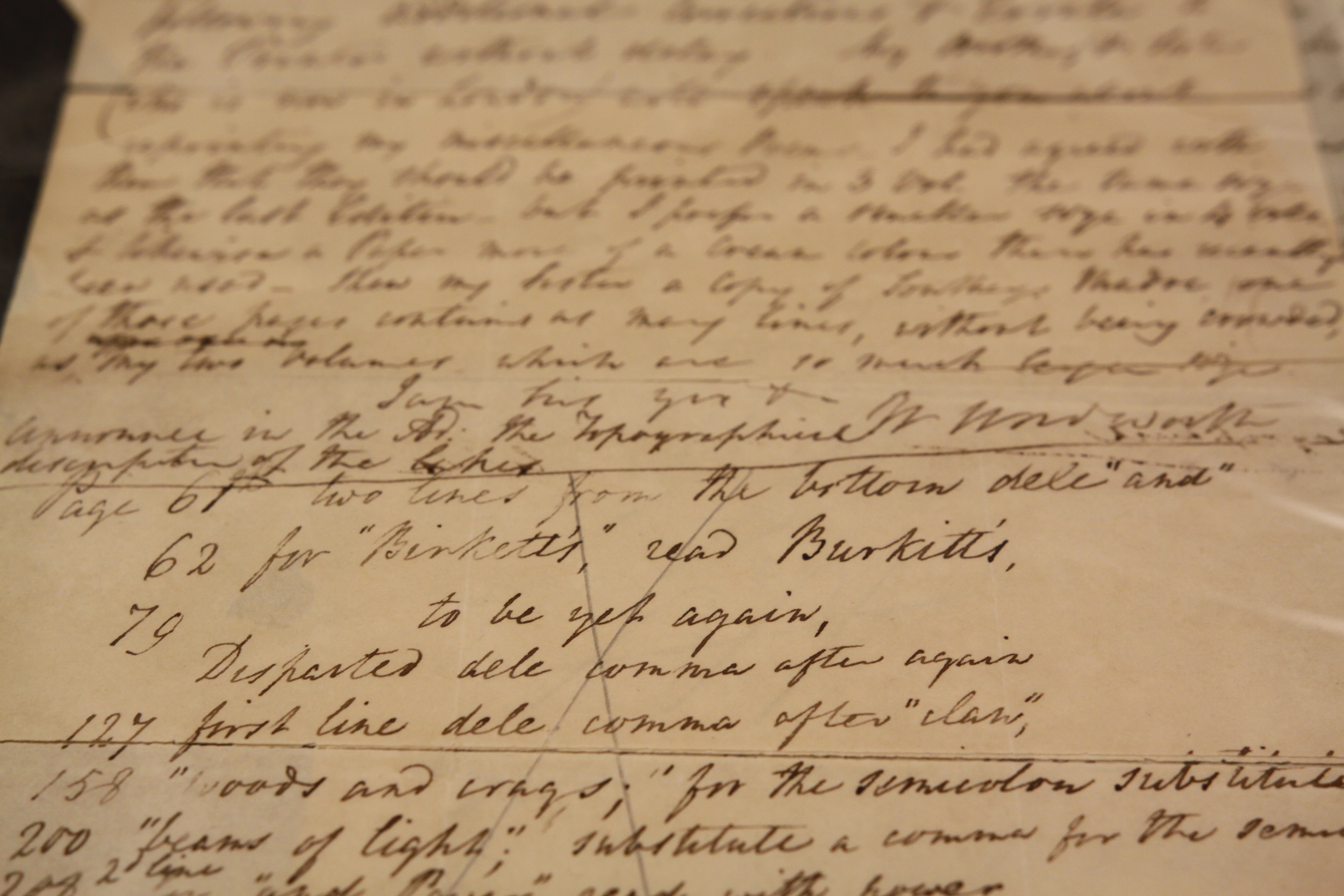
William Wordsworth to Longman, 11 April 1820 - MS 1393 2/67/2

William Wordsworth to Longman, 11 April 1820 (MS 1393 2/67/2).

Before I started working at the University of Reading Special Collections, I spent a year in Grasmere working with the collections at the Wordsworth Trust. Before that I studied for a BA and an MA in English Literature and centred both of my dissertations on William Wordsworth. So by the time I left Grasmere at the start of 2015 it’s fair to say that I had the poet, his work and legacy firmly etched in my mind. My first search on the University of Reading Special Collection’s online catalogue was, not surprisingly, for ‘William Wordsworth’. To my delight there was a result: a single letter written by Wordsworth from 1820. The majority of original Wordsworth manuscripts are housed by the Wordsworth Trust but a few can be found scattered in archives across the world. The reason an example can be found in Reading is because it is part of the Longman Group Collection, the firm responsible for publishing much of Wordsworth’s work during his lifetime.

R. G. Longman's volume of letters.

R. G. Longman’s volume of letters (MS 1393 2/67).

The letter doesn’t stand alone. It is housed in a small volume with other letters to Longman by Wordsworth’s sister Dorothy as well as his friend Samuel Taylor Coleridge. It belonged to R. G. Longman and these letters were clearly treasured by the Longman family as the volume was created especially to house them. You’d be forgiven for thinking that the volume contained only letters written by Coleridge as his name is the only one to grace the spine. A note inside the cover states: ‘4 ST Coleridge letters left to me by my uncle, T. N. Longman’. A further note underneath this was added many years later recording the addition of the letters by William and Dorothy. Given the strong bond of love and friendship between the three of them, it seems only fitting that the letters should reside together.

The inside cover of R. G. Longman's volume of letters, with the inscription '4 ST Coleridge letters left to me by my uncle, T. N. Longman’.

The inside cover of R. G. Longman’s volume of letters, with the inscription ‘4 ST Coleridge letters left to me by my uncle, T. N. Longman’.

The year 1820 saw Wordsworth at a mid-point in his life as a writer. His ‘golden decade’ (1799-1808), during which he wrote the majority of his greatest works, was behind him and widespread fame and notoriety was still a few years ahead.  On the 11 April 1820 he wrote to Longman asking them ‘to transmit the following additional corrections and Errata to the Printer without delay.’ The alterations were for The River Duddon, a series of sonnets about the river in his native Lake District following it from its source to the sea. He was also concerned about the reprint of another of his volumes, Miscellaneous Poems, and gave precise instructions as to how he wished it to be printed. After initially favouring three volumes, he wrote ‘I prefer a smaller size in 4 vols. and likewise a Paper more of a cream colour than has recently been used.’  The exchange of manuscripts, proofs and corrections between writer and publisher would take a lot longer than it would today, especially in the case of Wordsworth who is famous for his constant desire to revise his work, and that he lived far from the publishing centre of London. This letter came late in the preparation process as the Longman divide ledger shows that The River Duddon was published by the end of April.
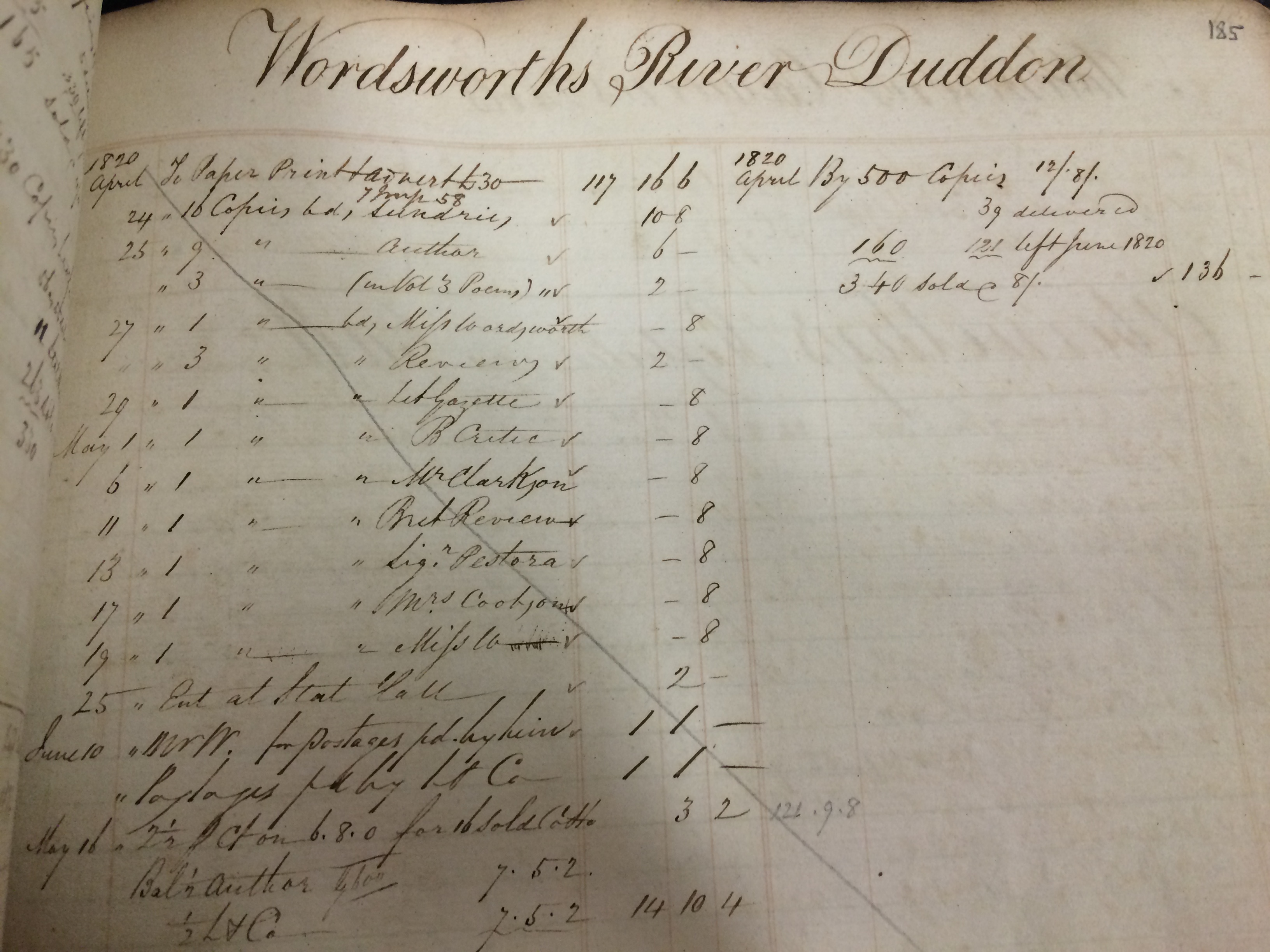
Divide ledger entry for 'Wordsworth's River Duddon' MS 1393 1/A3

Divide ledger entry for ‘Wordsworth’s River Duddon’ MS 1393 1/A3

What’s wonderful about the context of this letter is that the publication history can be traced beyond the letter itself using the same archive. Much of Wordsworth’s poetry is celebrated for its quality, but did it sell?

The River Duddon was printed in an edition of 500 copies and 14 years after it was first published there were 30 copies left unsold. These figures are roughly in line with Wordsworth’s previous volumes demonstrating a consistent but fairly low circulation among the reading public of the time. This changed as his popularity grew, and it’s interesting that the postscript of this letter (‘Announce in the Ad [for The River Duddon]: the Topographical description of the lakes’) refers to a work that would go on to outsell anything Wordsworth had written before. In 1810 he supplied a description of the Lake District to accompany a set of etchings by the Revd Joseph Wilkinson, however his name was not attributed to it. The River Duddon volume, therefore, was the first proper outing of the work fully credited to Wordsworth, but here it was still an addition to something else.  When it was published separately for the first time in 1822 in an edition of 500 copies, it quickly sold out within the year and a second edition was published in 1823 amounting to 1000 copies which went on to sell out as well. This makes sense because the guidebook market in the early nineteenth century was saturated by guides to the Lake District which was fast becoming one of the places to travel to. Although Wordsworth seemingly added to a large market of literature on the subject, his Guide to the Lakes (as it became known) stands out above the rest in its unique approach to landscape. The majority of picturesque guidebooks at the time directed tourists to designated ‘stations’ where they could find a suitable viewpoint. Wordsworth’s Guide, written with an insider’s perceptive, considers the landscape as a whole and how people can be emotionally affected by nature.

Having researched and written about Wordsworth’s Guide whilst I was at university, it’s fascinating to see an early mention of it in such a peripheral manner. In fact, it’s rather nice to know that his handwriting, so familiar to me after my time in Grasmere, is just down the corridor.

You can find out more about the Longman Group Collection here, and how to access our archives here.
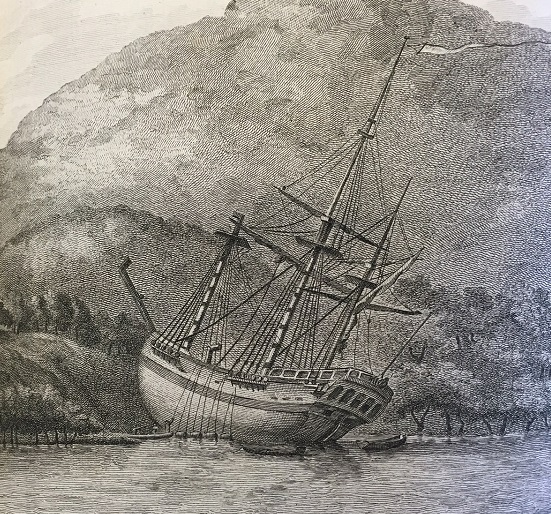
 

Travel Thursday: Captain Cook and H.M.S Endeavour

Written By Louise Cowan, Trainee Liaison Librarian

This month sees the anniversary of the first European ship landing in Eastern Australia. Led by

H.M.S. Endeavour

H.M.S. Endeavour

British explorer, James Cook, the crew of the H.M.S. Endeavour reached Botany Bay at the end of April 1770.

The Special Collections Library has a number of volumes on the voyages of Captain Cook but the narrative in “An Account of the Voyages Undertaken by the Order of his Present Majesty for Making Discoveries in the Southern Hemisphere and Successfully performed by Commodore Bryon, Captain Carteret, Captain Wallis and Captain Cook in the Dolphin, the Swallow and the Endeavour,” by John Hawkesworth (1773), is perhaps one of the most detailed.  The reason for this is clearly explained by Hawkesworth himself in the preface to volume II:

The papers of Captain Cook contained a very particular account of all the nautical incidents of the voyage, and a very minute description of the figure and extent of the countries he visited […] But in the papers of Mr. Banks, I found a great variety of incidents which had not come under the notice of Captain Cook…

Mr. Banks, or Sir Joseph Banks, was an explorer, naturalist and president of the Royal Society who accompanied Cook as the lead scientist on the voyage.  Hawkesworth combines the journals of both Cook and Banks to give a thorough and detailed survey of the journey.

As the first scientific expedition to the Pacific (Villiers, 2016) the voyage had set out with two main goals; the first was to observe the transit of the planet Venus across the Sun on 3 June 1769 at Otaheite (Tahiti):

The whole passage of the planet Venus over the Sun’s disk was observed with great advantage by Mr Green, Dr Solander, and myself.

The second aim was to find the theoretical southern continent ‘Terra Australis’.   So, on leaving Tahiti,

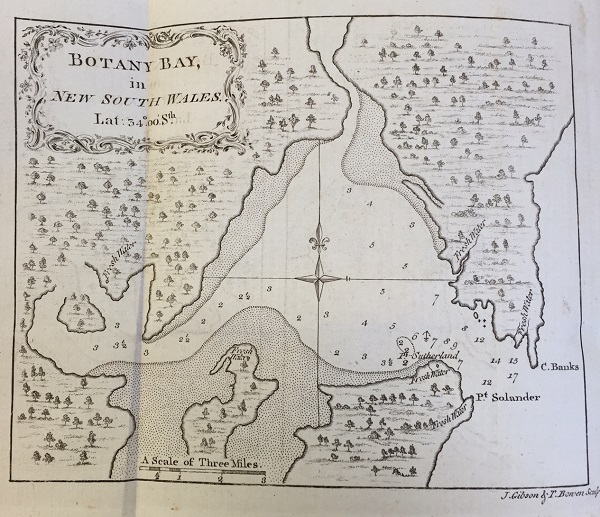
Map of Botany Bay

Map of Botany Bay

Cook opted for a route divergent to his predecessors, sailing south and southwest, (Villiers, 2016), a decision which led him to the discovery of New Zealand.  He and his crew spent several months exploring and charting the island before sailing on to Australia, where they made their first landing at Botany Bay:

The place the ship had anchored was abreast of a small village, consisting of about six or eight houses […] we intended to land where we saw the people, and began to hope that as they had so little regarded the ship’s coming into the bay, they would as little regard our coming on shore: in this however, we were disappointed; for as soon as we approached the rocks, two of the men came down upon them to dispute our landing, and the rest ran away.

They stayed at Botany Bay for eight days, and despite several brief encounters, the Captain and his crew were unable to make significant contact with the Aboriginal people, who were unsettled by the new arrivals, often throwing lances at the crew or running away in fear:

A lance was immediately thrown at him out of the wood, which narrowly missed him.  When the Indians saw that the weapon had not taken effect, they ran away.

Although Cook and his crew were unable to form any fruitful relationships with the people they encountered on this occasion, Mr Banks and his assistant, Dr. Solander, a Swedish botanist, were able to collect a wealth of botanical materials, earning the Bay its name:

The great quantity of plants which Mr. Banks and Dr. Solander collected in this place induced me to give it the name of BOTANY BAY.

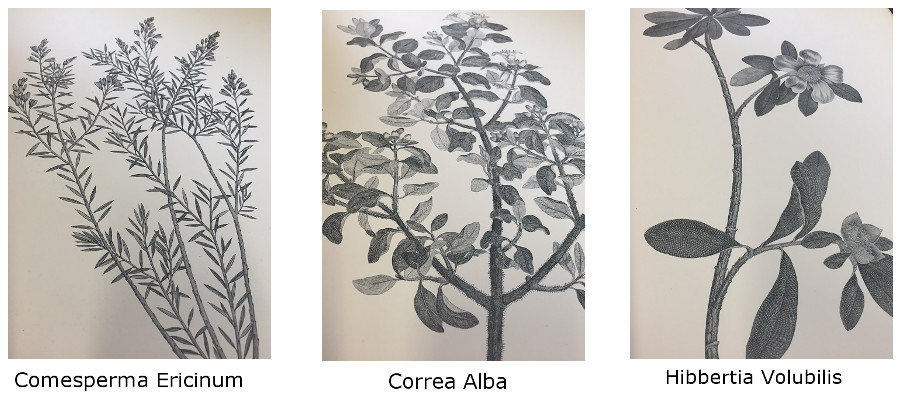
The Special Collections Library holds a copy of ‘Illustrations of the Botany of Captain Cook’s Voyage Round the World in H.M.S. ENDEAVOUR in 1768-71’ by Sir Joseph Banks and Dr. Daniel Solander, (1900).  The two part work contains beautiful engravings of a number of plant specimens, including some of those Banks and Solander found at Botany Bay:

Plants collected by Banks and Solander at Botany Bay

Plants collected by Banks and Solander at Botany Bay

The success of the expedition for Sir Joseph Banks and his team helped to establish the tradition of sending scientists on naval voyages and inspired interest not only in the discovery of new lands but in the possibility of new discoveries in science, (Villiers, 2016).

Following this journey, Cook continued his epic sea voyages, his explorations eventually showing that, “a real Terra Australis existed only in the landmasses of Australia, New Zealand, and whatever land might remain frozen beyond the ice rim of Antarctica,” (Villiers, 2016).


Sources:

Hawkesworth, J. (1773) An Account of the Voyages Undertaken by the Order of his Present Majesty for Making Discoveries in the Southern Hemisphere and Successfully performed by Commodore Bryon, Captain Carteret, Captain Wallis and Captain Cook in the Dolphin, the Swallow and the Endeavour. [Overstone Shelf 26 E – Available on request]

Banks, J., Solander, D (1900) Illustrations of the Botany of Captain Cook’s Voyage Round the World in H.M.S. ENDEAVOUR in 1768-71’ [Reserve Middle Folio 581.944 BAN – Available on request]

Alan John Villiers (2016) James Cook. Britannica Academic. Available from: http://academic.eb.com.idpproxy.reading.ac.uk/EBchecked/topic/135983/James-Cook

Sir Joseph Banks 2016. Britannica Academic. Retrieved 27 April, 2016, from http://academic.eb.com.idpproxy.reading.ac.uk/EBchecked/topic/52035/Sir-Joseph-Banks

Incunables identified

Written by Erika Delbecque, UMASCS Librarian

Last month we wrote about the process of identifying loose leaves from incunables, books printed in Europe before 1501. We also asked for your help in identifying the remaining four leaves. With help from Geert Lernout and the team behind the Gesamtkatalog der Wiegendrucke, all leaves have now been identified!

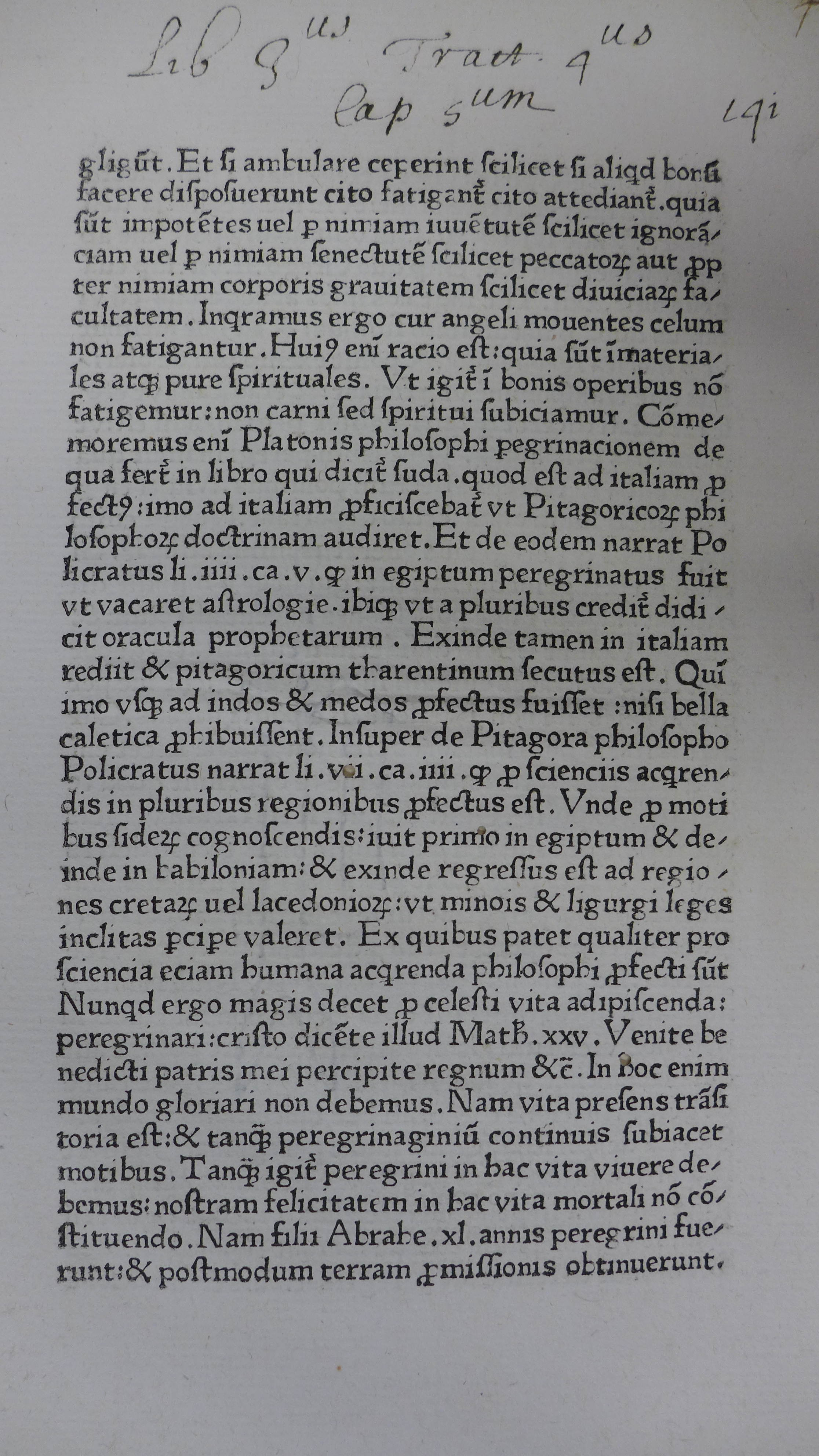
The leaf below was identified as part of Jacobus Magni’s Sophologium, printed by Adolf Rusch around 1470. It is a popular anthology of extracts from ancient and medieval writers including Muhammad Abu Mashar (Persian astrologer), Seneca, and Chaucer. Adolf Rusch (1435-1489) was a printer and paper merchant based in Strasbourg. He was one of the first printers north of the Alps to start using roman instead of Gothic type. Because he did not include his name in the books he printed, he was initially known only as the “R-printer”,  referring to a special Roman type capital “R” he uses in his early works. An example of this letter is included on our leaf. Some have argued that it is in fact a monogram derived from his initials, A.R.

Unidentified edition of Summa de exemplis by Giovanni da San Gimignano. May be early 16th century

Magni, Jacobus. Sophologium. Strassburg: The ‘R-printer’ (Adolf Rusch), about 1470.

The  striking capital R used by Adolf Rusch

The striking capital R used by Adolf Rusch

A complete copy of this publication can be browsed online here.

The other unidentified fragments were identified as a leaf from Casus longi Sexti et Clementinarum by Élie Regnier (Strasburg, 1496), a leaf from Agenda sive Benedictionale (Basel, 1518) and a leaf from Postilla super totam Bibliam by Nicolaus de Lyra (Rome, 1471-72).

Memoir on the Dodo

Written by Louise Cowan, Trainee Liaison Librarian

One of the interesting finds from our cataloguing and reclassification of the Cole Library Collection is ‘Memoir on the Dodo’ by Sir Richard Owen, an eminent English biologist and palaeontologist.

The initial discovery of Dodo remains in the mid nineteenth century led to some controversy in the scientific community.  Owen, who was somewhat notorious for his ruthless behaviour, is said to have intercepted material intended for another researcher, Alfred Newton.  Owen then argued that, “possession of the best material was a prerequisite for publication priority, which provided him with a complete monopoly,” (Hume, Cheke & McOran-Campbell, 2009).  With the success of his application as a Professor in danger of being side-tracked by Owen, Newton was unable to complain and was forced not only to, “relinquish access to the best Dodo bones promised to him, but he also had to withdraw the Dodo manuscript that had already been submitted,” (Hume, Cheke & McOran-Campbell, 2009).

Despite the circumstances surrounding its author, Owen’s work remains a significant contribution to the Zoological sciences.

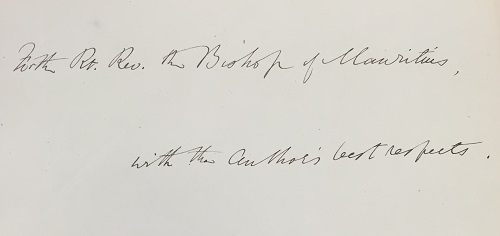
Author dedication to the Bishop of Mauritius

Author dedication to the Bishop of Mauritius

The book consists of a historical introduction by naturalist William John Broderip; an explanation from Owen on how he came to be in possession of the collection of bones discovered on Mauritius by George Clark in 1865, and finally a description of these bones alongside several illustrative lithographic plates.  According to Hume, Cheke & McOran-Campbell (2009), the book had a limited run of only 100 copies with 20 intended for presentation to Owen’s supporters.  Our volume is dedicated by the author to the Bishop of Mauritius; the friendship between the two having played a key role in Owen’s receipt of the Dodo remains.

Broderip’s introductory history focuses on both written and pictorial evidence for the existence of the Dodo.  He examines first-hand accounts from travellers to Mauritius from as early as 1598, quoting their descriptions of the bird.  The following is from  Jacob van Neck and Wybrand van Warwijk’s

Drawing of a Dodo by Jacob van Neck and Wybrand van Warwijk

voyage in 1598:

As large as our swans, with large heads, and a kind of hood thereon; no wings, but, in place of them, three or four black little pens (penekens), and their tails consisting of four of five curled plumelets (Pluymkens) of a greyish colour.


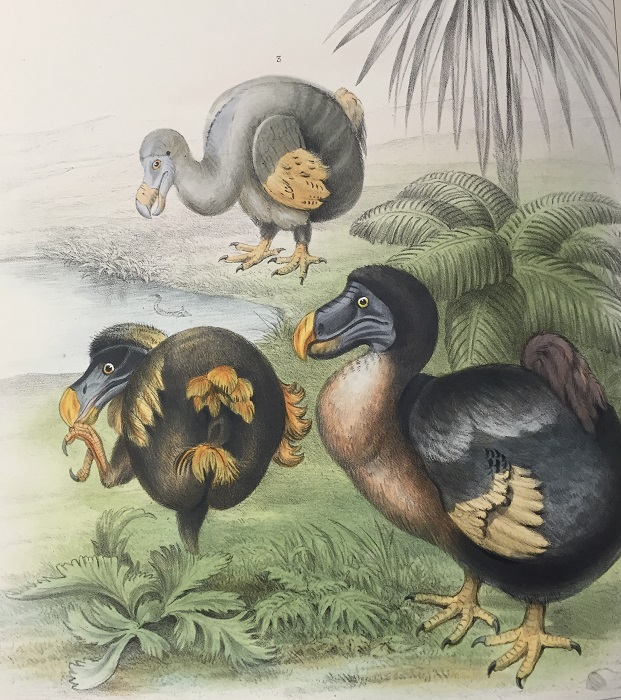
Broderip also makes mention of the Dodo remains held in Oxford and the remains of a leg that had been held by the British Museum.  Following Broderip’s death, Owen took up the narrative, describing other museum artefacts as well as art works featuring the Dodo.  All three Dodos depicted in this beautifully coloured plate (below), taken from the front of the book, are from paintings by Roelandt Savery, a Flemish-born Dutch Painter.  Owen combined the figures to create an ‘Ideal scene in the island of Mauritius before its discovery in 1598.’

Composite picture of Roelandt Savery's Dodos

Composite picture of Roelandt Savery’s Dodos

However, Owen’s belief that Savery’s paintings were drawn from a living bird, caused him to make a serious mistake in his reconstruction of the creature.  Owen recreated the bird’s image by fitting the skeleton into an outline traced around Savery’s Dodo image but, “this produced an unnatural, squat and overly obese Dodo,” (Hume, Cheke & McOran-Campbell, 2009).  While Owen rectified his error in a later publication, the original image stuck and remains a common misconception.


Outline of a Dodo skeleton using a tracing from Roelandt Savery's Dodo paintings

Outline of a Dodo skeleton using a tracing from Roelandt Savery’s Dodo paintings


Sources:

 Owen, R. (1866) Memoir of the Dodo. London: Taylor and Francis [COLE 196F/103 – available on request]

  • A scan of ‘Memoir of the Dodo’ is available here.
  • P. Hume, A.S. Cheke & A. McOran-Campbell (2009) How Owen ‘stole’ the Dodo: academic rivalry and disputed rights to a newly-discovered subfossil deposit in nineteenth century Mauritius, Historical Biology, 21:1-2, 33-49

New exhibition: Ex libris – marks of ownership in rare books from the University of Reading Special Collections

Rare books often contain a variety of features which make them important and interesting historical artifacts beyond their texts. Marks of ownership and provenance can reveal not only who once owned a book, their profession and an indication of their interests and character, but also where they acquired the volume, what they paid for it and their opinions about the text. Ownership marks also serve to document the unique history and journey of a book as it passes through the hands of different owners over time.

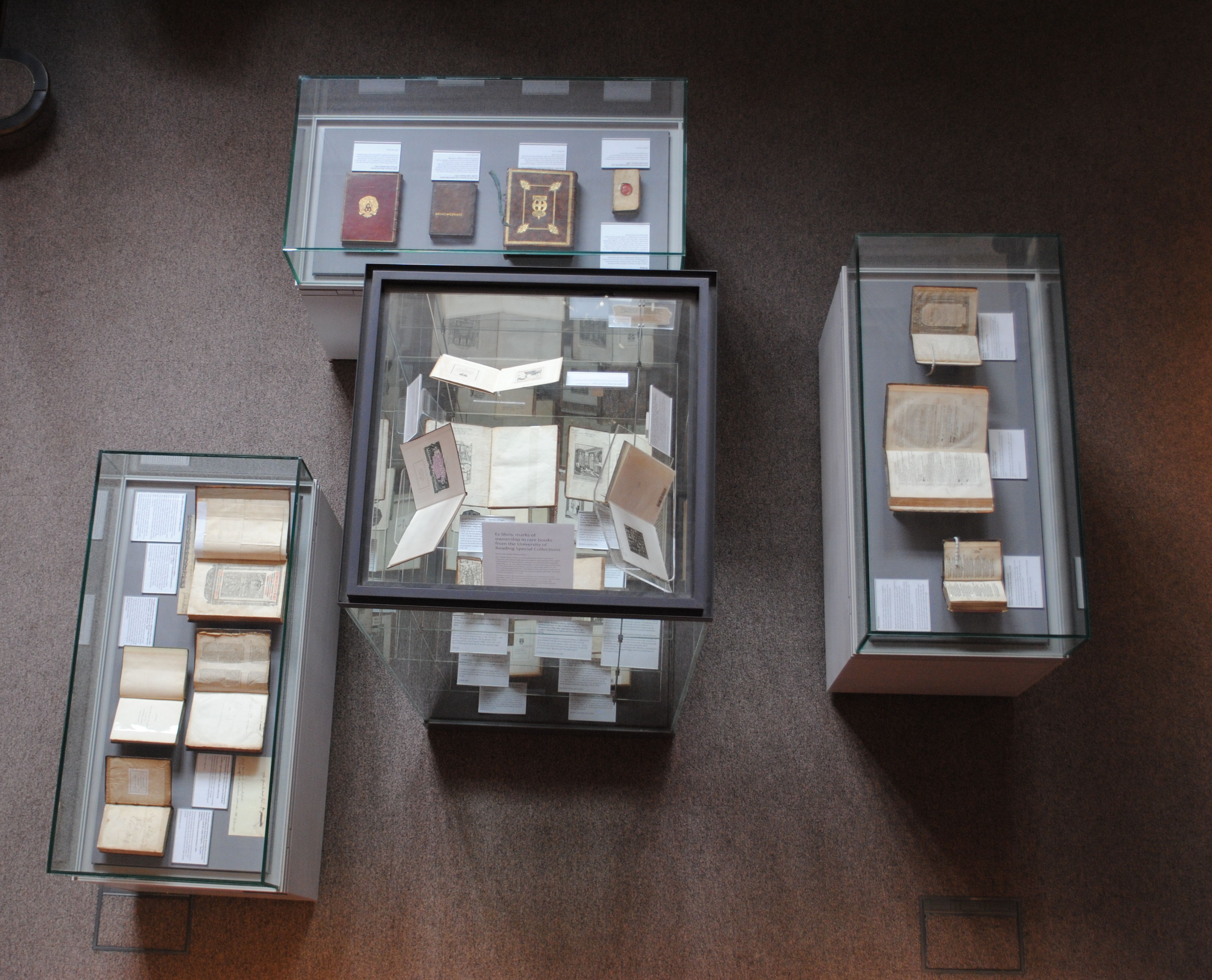
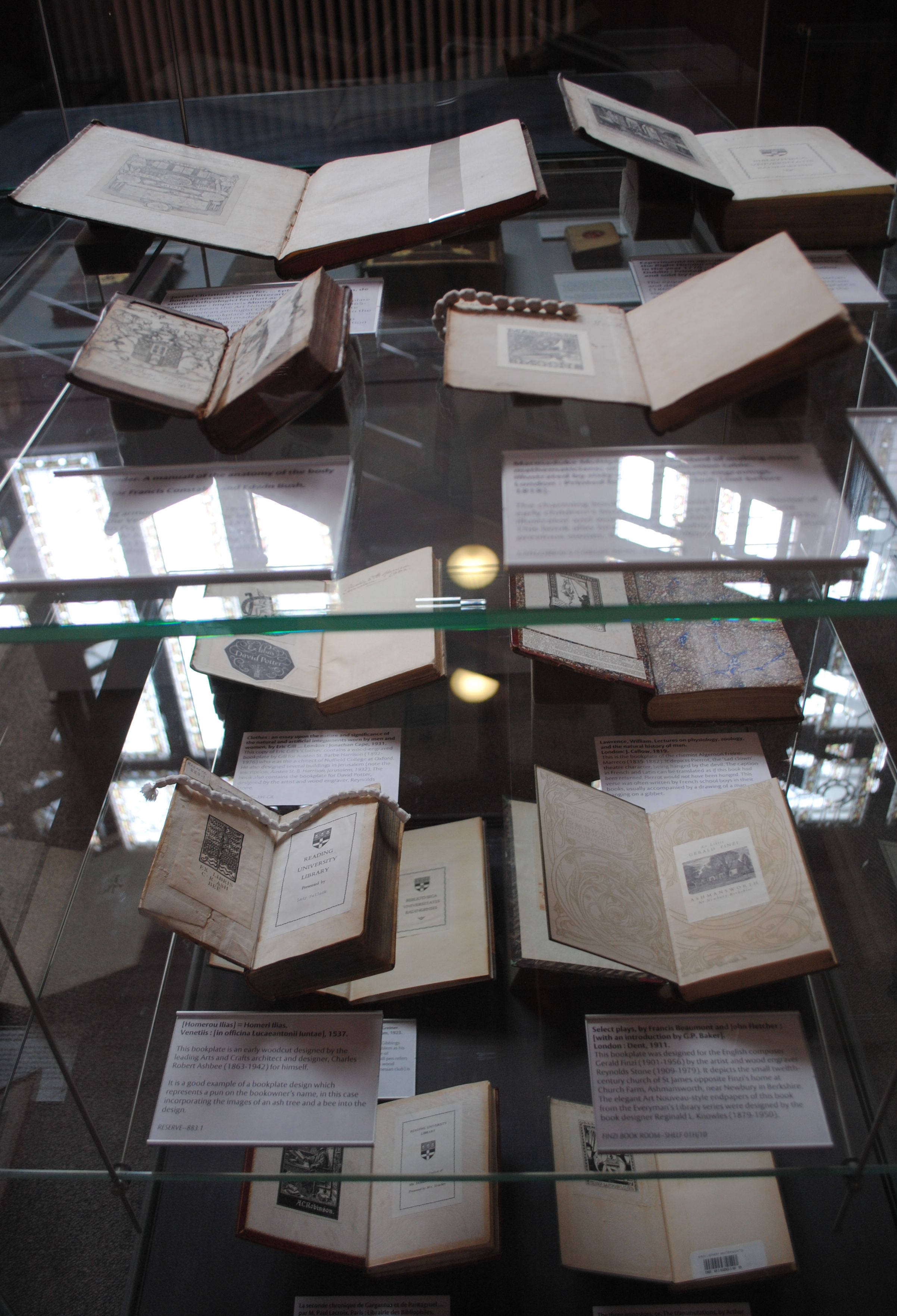
Our new exhibition, ‘Ex libris – marks of ownership in rare books from the University of Reading Special Collections’, invites the viewer to explore the private relationship between readers and their books, and the variety of different ways in which book owners (both famous and long forgotten) from the seventeenth to the twentieth century have indicated ownership of their books through the use of bookplates, decorated bindings, inscriptions and annotations.

view of exhibition


One of the items that is on display is this extraordinary binding on a 1664 edition of Justin’s History, in which a wax portrait was inserted. Before the 1830s, when automated bookbinding was introduced, bookbinding was carried out by trained artisans working individually or in small workshops. Customers often had their bindings personalised, usually by having their initials or coats of arms stamped onto the leather. This previous owner, however, appears to have come up with this original way of conveying his ownership of the book.


bindings

Iustini historiarum ex Trogo Pompeio lib. XLIV. Amsterdam: Elzevier, 1664. RESERVE–878.9-JUS

Ce4CBJDWwAAKxth

This book, a set of six metaphysical exercises, was designed for university use. A previous owner has had several additional blank pages added to the book, and filled them with copious notes in shorthand on metaphysical problems.

annotations

Thomas Barlow. Exercitationes aliquot metaphysicæ de Deo. London : Richard Bishop, 1640. RESERVE 110 BAR


The exhibition also includes a large selection of bookplates. A bookplate, or ex libris (meaning ‘from the books of’), is a small print or decorative label, usually produced as an engraving, for pasting inside the cover of a book to express ownership. The use of bookplates as marks of ownership dates back to the last quarter of the fifteenth century.

Bookplates

The exhibition will be on display in the staircase hall at the Special Collections Service until 1 July 2016.

Art Collections in Conversation

Art Collection


Art Collections in Conversation: a series of FREE 45-minute lunchtime events


An opportunity to see and collectively discuss material from the University of Reading’s diverse Art Collections in a series of object-focused events.

Artworks which are usually in storage will be brought to venues around campus.

Learn how to access and use the Art Collections within your research. Led by the University’s Art Collections Officer, Collections Officer and invited guests.

Each event will be broadcast live via Periscope. Live Periscope streams can be accessed through the University of Reading’s Art Collections twitter @UniRdg_ArtCol


Free to attend, but booking is essential.

No food or drink is permitted.


Information about the Art Collections

The University of Reading has an eclectic Art Collection. Artistic works are held within the University’s Special Collections, and within the University’s museums – including the Museum of English Rural Life.

A number of significant artists are represented. This includes: Camden Town Group member Walter Sickert, printmaker Stephen Buckley, surrealist painter and poet Julian Trevelyan, figurative painter Leon Kossoff, Isotype pictogram designer Gerd Arntz, master of the woodcut Allen W. Seaby, cubist Max Weber, engraver Stanley Anderson, abstract photographer Alvin Langdon Coburn, renowned naturalist painter Charles Tunnicliffe, 17th century Baroque artist Peter Paul Rubens, and many others. The collection includes oils, works on paper and printmaking practices.

Artworks relate to the history of the University, its teaching methods and the varied interests of individuals who have acquired works for the collection over the years. The collection is further enhanced by the work of previous students.

The University of Reading also cares for over 700 boxes of original artwork used to illustrate  Ladybird children’s books.

The University continues to inventory and catalogue the Art Collections. As we do this, the intention is to build the profile of the collections. Our aim is to make the artworks accessible and relevant to the University’s students and specialist researchers. We would like to continue to engage a wider community of users, including the public.


Cliveden House Exhibition

At the end of February, staff from Special Collections were joined by students of the history department at Cliveden House in Buckinghamshire to showcase material from the Nancy and Waldorf Astor Archives. The material for the exhibition was chosen by the students as part of their discovering archives and collections module during the autumn term when they spent several weeks in the reading room at Special Collections. During that time they helped to catalogue the myriad of names in the Cliveden visitor books, got the chance to shadow archive staff and organise the material that formed the basis of February’s exhibition.

Students with Dr Jacqui Turner and Guy Baxter (University Archivist) in the reading room (Photo: Jacqui Turner)

Students with Dr Jacqui Turner and Guy Baxter (University Archivist) in the reading room (Photo: Jacqui Turner)

This is the second year in a row that students have had the chance to co-curate an exhibition at Cliveden and it proved just as popular with visitors as last year, if not more so. The exhibition offered a rare opportunity for visitors (including hotel guests and staff, as well as the National Trust staff that work on the Cliveden estate) to see original documents in their original setting.

Students at Cliveden House with general manager Sue Williams (Photo: Jacqui Turner)

Students at Cliveden House with general manager Sue Williams (Photo: Jacqui Turner)

You can see more of the display and find out more about the project in this short video:

https://www.youtube.com/watch?v=8zVcHPNLMGE

The exhibition was separated into different themes including women’s suffrage, the Cliveden estate and the Cliveden stud. Hear more about the aspects of the exhibition in this conversation between Dr Jacqui Turner and two of the students who co-curated the exhibition:

https://www.youtube.com/watch?v=0A1fqc0MdNI

The Nancy and Waldorf Astor archives can be accessed in our reading room. For more information about accessing our collections, click here.

Travel Thursday – A Journey from Aleppo to Jerusalem at Easter

Written by Louise Cowan, Trainee Liaison Librarian

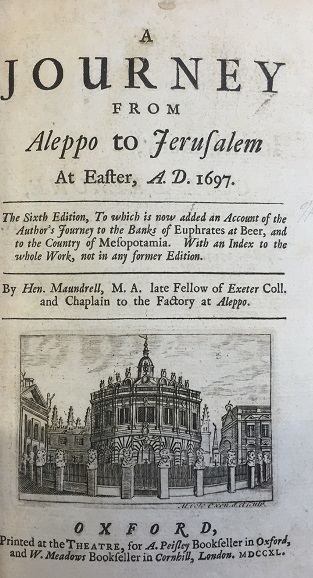
IMG_9551‘A Journey from Aleppo to Jerusalem at Easter A.D. 1697’ was written by Henry Maundrell, a Church of England clergyman and chaplain to the Levant Company’s factory at Aleppo in Turkey.  Maundrell went on a pilgrimage to Jerusalem in 1697 and the journal he produced on his journey is described as being a ‘minor classic’ (Howell, 1964) in the world of travel writing.  Originally published in 1703 it reached its twelfth edition by 1810 and was translated into three different languages (Butlin, 2004).

The success of this particular travelogue is attributed to the precise, detailed and factual accounts given by Maundrell.  Howell (1964) describes this style of writing as being like that of, “a fine reporter, detached, cool and observant.”  Amusingly, in the preface to his uncle, Maundrell himself describes his style as ‘dry’, ‘tedious’ and ‘nauseous’; apologising for it profusely:

When you are tired with reading it, you may support your Patience as we did in Travelling it over, by considering, that what you are about is a Pilgrimage; that you need go it but once.

Despite Maundrell’s humility and reluctance to publish his work, his friends realised its potential and were able to persuade him otherwise.  Maundrell intended to submit the work with some corrections and amendments but by the time these arrived in Oxford, the first edition was almost complete.  Later editions, such as our sixth edition copy, printed in 1740, do however, contain the additions.

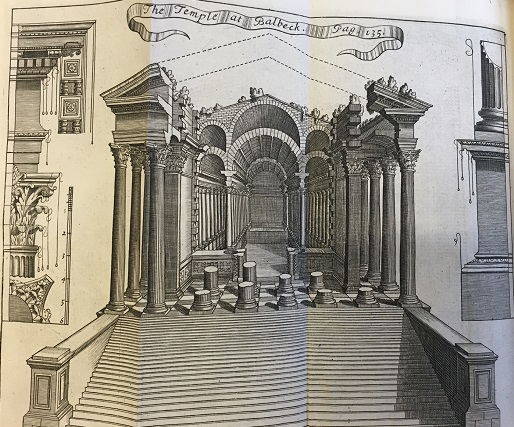
Temple of Baalbek

Temple of Baalbek

Maundrell’s observant and detached style is easy to illustrate, take this example from his description of the Temple of Baalbek in Lebanon:

The Body of the Temple, which now stands, is encompassed with a noble Portico, supported by Pillars of the Corinthian Order, measuring six foot and three inches in diameter, and about forty five foot in height, consisting all of three Stones a piece.

The detail with which Maundrell describes the Latin Easter in Jerusalem is equally staggering and moreover, provides a fascinating insight into the festival in 1697.  Confined to the Church of the Holy Sepulchre on Mount Calvary for three days, Maundrell explores every inch of the building, describing everything from the history, to the thirteen sanctuaries dedicated to the life of Christ and the various apartments for the reception of “almost every Christian Nation.”

The ceremonies begin on Good Friday (Nox tenebrosa) with a solemn procession around the church.  This begins in the dark with a sermon in Italian, then candles are lit and a large crucifix, “which bore upon it the Image of our Lord, as big as life[…]was carried all along in the head of the procession; after which the company follow’d to all the sanctuaries in the church, singing their appointed Hymn at every one.” This is followed by a symbolic re-enactment of the crucifixion and burial of Christ and a final funeral sermon in Arabic.

On Saturday Maundrell provides an interesting commentary on the pilgrims who have their, “arms mark’d with the usual ensigns of Jerusalem,” giving a detailed description of the tattoo process involving needles and ink made from gunpowder and ox-gall.

Finally, Easter Sunday was celebrated with a mass led by the ‘Father Guardian’ who was adorned in episcopal robes and mitre.  Maundrell (a little cheekily) suggests that the joy the Friars display on Easter morning perhaps has a little more to do with the end of Lent than their celebration of the Lord’s resurrection.

Although Maundrell can be critical of the places and customs he describes, his writing is often witty and well informed,  it was valued by later travellers and moreover, remains an important account of the, “the life and landscapes of Syria, Lebanon, and Palestine” (Butlin, 2004) for today’s writers, travellers and historians.

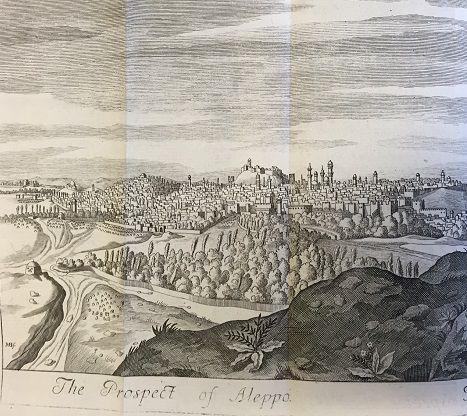
Aleppo

Aleppo

 When you come therefore to any such Nauseous places in this Journal, you may please to pass them over with that Contempt which they deserve, but nevertheless with some indulgence to the Writer of them; for if this Vanity may be ever tolerated, Travellers are the Men who have the best claim to that Favour.

Sources:

Maundrell, H (1740) A Journey from Aleppo to Jerusalem at Easter A.D. 1697. Oxford: Peisley & Meadows [Available on request – Overstone 27/c]

Howell, D (1964) The Journey Of Henry Maundrell. Saudi Aramco World. Available via: http://archive.aramcoworld.com/issue/196404/the.journey.of.henry.maundrell.htm

Butlin, R.A. (2004) ‘Maundrell, Henry (bap. 1665, d. 1701)’, Oxford Dictionary of National Biography, Oxford University Press. [http://www.oxforddnb.com.idpproxy.reading.ac.uk/view/article/18378, Accessed 23 March 2016]

College Song No. 1, “The Song of the Shield”

Written by Guy Baxter, Archivist

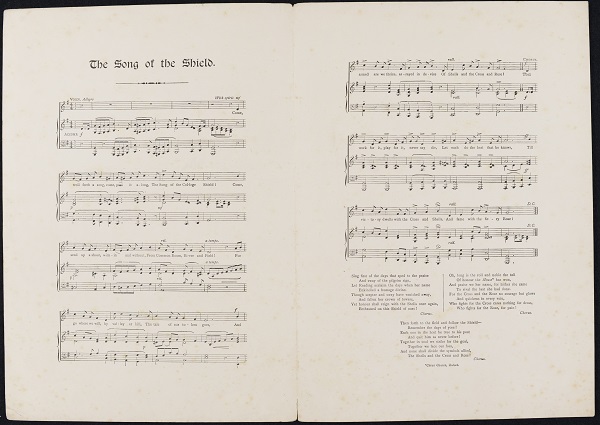
The Song of the Shield

The Song of the Shield

Since the University celebrated the 90th anniversary of the granting of its Royal Charter last Thursday, many people have been asking for the words of College Song No. 1, “The Song of the Shield”, which was performed with gusto by the University Chamber Choir that evening under the direction of Samuel Evans. It was discovered in the University Archive just a few months ago.

The music was written by J.C.B. Tirbutt (1857-1908), who lectured at Reading and who was the organist at All Saints church. The words are by the then

Sheet music for 'The Song of the Shield'

Sheet music for ‘The Song of the Shield’

Principal (and later Vice-Chancellor) W.M. Childs (1869-1939). More about the

inspiration for the song, the Coat of Arms, may be found here, and it is fitting that the original Grant of Arms from 1896 was on display last Thursday as well.  As for the style: well, it’s unlikely to be covered by will.i.am any time soon, but it’s very jolly and evokes a strong sense of the College in its early days when everyone would have known each other. Rumours of compulsory singing of the song before every lecture next term are thought to be unfounded.

Lyrics for 'The Song of the Shield'

Lyrics for ‘The Song of the Shield’

Congratulations to all involved in bringing this hidden piece of our past to light. The other music performed at the meeting of the University Court on 17 March included Prelude and fugue in C minor BWV 549 by J.S. Bach, which was also performed at the inaugural organ recital in the Great hall in 1911; I Vow to Thee, My Country by Gustav Holst (words by Cecil Spring-Rice) – Holst taught at the College from 1920-1923; and My Spirit Sang All Day, No.3 from Seven Part Songs op.17 by Gerald Finzi, whose literary collection is held here

Special Collections will continue to support the 90th Anniversary events with a series of displays during the Summer and Autumn.

A relic of an 18th century poet to mark World Poetry Day

Written by Fiona Melhuish, UMASCS Librarian

Tucked away in one of our archive boxes is an envelope which contains a small, folded piece of paper which, when opened carefully, reveals a tiny fragment of netting, woven from fine string (University of Reading Special Collections MS 12) [see image below]. It is attached to the paper by four pieces of red sealing wax. The paper has been folded and addressed To Mrs Jenning(?) With most affectionate and grateful regard.

Cowper netting1


Beneath the netting, a slip of paper has been attached upon which is written the line  – ‘Thus, all their plan adjusted, diff’rent ways/They took,’. Beneath this, in another, perhaps later, maybe nineteenth-century, hand, is written the following:

This netting was made by the Poet Cowper, his ‘The Task’ – “Weaving nets for bird-alluring fruit &” – The hand writing is also The Poet’s, being a part of his Homer.

Attested by Maria D. Johnson – widow of The Poet’s beloved kinsman – Dr Johnson. The seal, of which these hares are the impression, was the gift of the Princess Elizabeth to the late Lady Hesketh, and bequeathed by her in her will to the late Dr Johnson’.

Cowper netting2


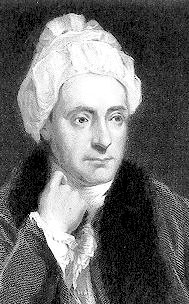
William Cowper (pronounced “Cooper”) (1731–1800) [see portrait below]  was one of the most popular poets of his time. He was influential in the development of eighteenth-century nature poetry, drawing on scenes from everyday life and the English countryside, and was admired by other poets including Coleridge, Wordsworth and Blake.

Cowper portrait


His most substantial poetic work was The Task, a poem in blank verse which begins by focusing on the origins of the sofa, but develops into a meditation on a wide variety of subjects, including nature, the retired life and religious faith, and includes attacks on slavery, the clergy and blood sports. However, he regarded his translations of Homer’s Iliad and Odyssey into blank verse as his greatest achievement. The handwritten line on the slip of paper beneath the netting is from Cowper’s translation of Homer’s Odyssey, and, according to the inscription, was written in Cowper’s hand. I have not yet investigated what link the line from Homer might have with the piece of netting.

Cowper suffered from bouts of severe depression throughout his life, and was institutionalised for insanity in the period 1763–65. However, he had close friendships with his cousins, the writer John Johnson and Lady Harriett Hesketh (both mentioned in the inscription). According to Thomas Wright, one of Cowper’s biographers, Lady Hesketh stayed with the poet during one of his periods of mental illness in 1794/95. During this time she wrote in a letter that during the winter of 1794/95 he seemed to improve, and that she was “able to get him to employ himself with “little avocations, such as netting, putting maps together, playing with the solitary board, &c.” Perhaps this little piece of netting was produced by Cowper as a therapeutic pastime to distract him during this period? As an appendix to his biography of Cowper, Wright includes a list of ‘Some relics of Cowper and their present owners (1892)’ which includes some ‘netting done by Cowper’, owned by the Rev. W. Cowper Johnson, junior, which, along with other relics of Cowper including his cap (worn by the poet when writing), was ‘exhibited in the Guelph Exhibition, 1891.’ It is not known if this piece of netting is the same as ours.

On closer examination, three of the four seals appear to feature a tiny image of a hare as mentioned in the inscription. The seal fob which is likely to have made these seal impressions is held by the Cowper and Newton Museum in Olney in Buckinghamshire. As Nicola Durbridge notes in an article about the seal fob on the Museum’s website, “the seals are carved with representations of Cowper’s three tame hares. Cowper nurtured these hares whilst he lived at Orchard Side, Olney and they were a great source of entertainment and companionship. Their names are incised on the seals: Puss, Bess and Tiney. Cowper published a long letter about his hare-keeping which gives us such a vivid picture of their characters and habits …”.


Cowper seal hare

One of the seals featuring an image of a hare


Durbridge also mentions that the seal fob “originally belonged to Lady Hesketh who had been given it by Princess Elizabeth, the daughter of George III and Queen Charlotte. Harriot moved in courtly circles and apparently met Princess Elizabeth whilst at Weymouth. For such a gift to have been made, Harriot must have become quite well acquainted with the Princess and regaled her at some point with stories of Cowper’s domesticated hares”. This confirms the information given in the inscription under the piece of netting. I cannot see any names above the images of the hares, but the creatures themselves can quite clearly be seen in three of the examples.

This piece of netting was one of our earliest archive acquisitions, but its provenance is unknown. I will be contacting the Cowper and Newton Museum to let them know about our curious little piece of Cowper memorabilia, and also to see if they can shed any light on the identity of the writer of the explanatory inscription, who Mrs Jenning(?) was and what link, if any, they had with William Cowper …

With thanks to Verity Andrews and Nancy Fulford, former members of the Special Collections archives team, for making this ‘discovery’ in the archive collections!

References 

Durbridge, Nicola. Lady Hesketh’s seal fob : a material world. (Olney : The Cowper and Newton Museum, 2012. (Accessed 16.03.2016).

King, James. William Cowper : a biography. (Durham, N.C. : Duke University Press, 1986). University Library STACK–821.65-KIN

Wright, Thomas. The life of William Cowper. (London : T. Fisher Unwin, 1892). University Library STORE–57796